College is a crucial developmental milestone for individuals whose ultimate goal is carving out a thriving career. More than the university diploma, a college degree is their motivational gateway to financial stability, career growth, and self-actualization of their personal goals and visions. According to a 2017 report, 5.1 million and 4.56 million students in the United States were enrolled in private and public colleges, respectively.

In 2015, the average bachelor's degree holder earned approximately $1 million more than a worker without one. Perhaps in part due to this trend, a related study in 2016 found that 60% of workers with a bachelor's degree and 77% of them with a post-graduate degree believe their job gave them a sense of identity. Only 38% of high school diploma holders or those with lower educational attainment feel the same. Roughly 94% of adults with a bachelor's degree or higher reported being happy in life, and only 89% of them without a college education said the same.
Did you know that only about 45% of high school students feel ready for college and careers? Eighty-seven percent of them said they want to go to college, nearly 3% do not, and 10% of them aren't sure. More than two-thirds of them will be attending a two- or four-year college.
Explore the sections on this article:
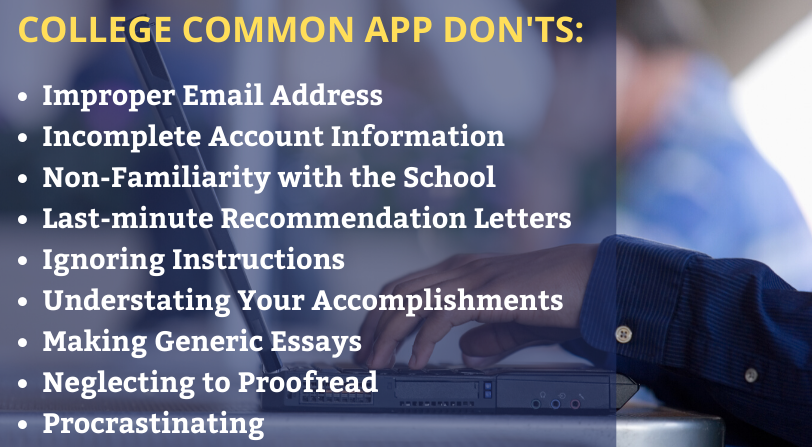
Conquering the College Application ProcessThe College Common AppNavigating the College Common AppCollege Common App Don'ts:* Improper Email Address* Incomplete Account Information* Non-Familiarity with the School* Last-minute Recommendation Letters* Ignoring Instructions* Understating Your Accomplishments* Making Generic Essays* Neglecting to Proofread* ProcrastinatingMake the Most Out of the Common App
Conquering the CollegeApplication Process
While many aspire for collegeeducation, the trends point to an obvious reality: for prospective collegestudents, the application process is a critical step. It is potentially themost challenging stage of a student's senior high career.
If our definition of successis only limited to admission from a preferred college or university, many whoexperience an undesirable outcome will feel like a disappointment tothemselves, their families, and society. But it doesn't have to be that way!
As the tedious process ofcollege application begins, students deal with a multitude of essayrequirements and application deadlines. Parental expectations and demands can alsoput more pressure on prospective students and push them to a specific limit.
What else do incoming college students have to deal with? Declining college application acceptance rates, tuition hikes, and employment uncertainties in a competitive job market drive, and the list goes on! The pressure is so high; it is driving students to the pits of depression.
Applying to a multitude of collegesis just one part of a prospective college's long list of to-dos. The Common Appeases your hectic life and saves you precious time.
The College Common App

The College Common Application,also known as Common App, is an online undergraduate college admissionapplication that incoming college students and transfer students can use to submittheir applications to multiple colleges and universities at once. Instead offilling out a new application separately for each of the many schools you'vepicked, you can use the Common App!
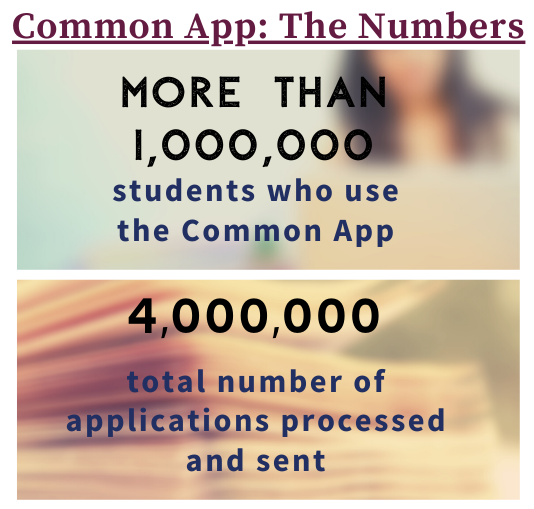
The Common App partners withmore than 800 private and public post-secondary institutions in 49 American statesand around the world to "reduce the barriers that students face when applyingto college. Today, the Common App is used by at least a million students whocollectively submitted over four million applications.
Through the Common App and other information (such as on-campus interviews or submitted portfolios), the school can decline, accept, or wait-list applicants. With over 2,000 colleges to pick from, you are almost guaranteed to succeed in at least one application.
Navigating the College Common App
Prospective college studentsoften find themselves checking out 10 or more schools, and could use the CommonApp as a vital tool that promotes manageability and accessibility. The sheernumber of documents and forms you need to complete can make the life of aprospective college student quite tricky. The Common App changes all that, too!
To start, create your applicationprofile with personal and demographic information including the familybackground. While there are standard requirements for college application, themain piece of paperwork you will need to be present is a transcript. You willalso have to furnish your Academic History, Extra-Curricular and SAT and ACTTest Scores, among others.
The Common App tracks allapplication materials and deadlines in one place. It's almost like having anassistant to see to it that all recommendation letters have been submitted, andcheck the documents that still need to be uploaded or sent.
Once the application is submitted to a college online, it cannot be changed for that college; you must contact the college directly to correct an error or provide more information. Remember, however, that the admissions team can interpret these negligent college application errors as a lack of effort.
Filling out the Common App isfree, but you may have to pay for your applications to be submitted to yourschools of choice. When your college application reaches the admissions officeof your preferred colleges or universities, you may be asked by the school tosubmit other pertinent documents. Depending on the school, you may be requiredto write essays. Your eligibility for financial assistance through FAFSA orschool-specific scholarship will also be evaluated.
Keep in mind these no-nos when using the Common App:Improper Email Address
First things first, to get the Common App started, an interested student needs to have a valid email address. As you apply to a college and preparing to be a professional one day, don't let an email address ruin that future opportunity. Never use email addresses that are not suitable for the professional environment. Your email address should not be inappropriate in any way, such as being silly, funny, suggestive, generic or flirtatious. If the email address, for example, is "partygirl@gmail.com" or "itsmylife@yahoo.com," the applicant is sending a wrong message to the college admission team.
The individual you're givingyour email address to automatically becomes a member of your professionalnetwork, so creating a separate email account for business purposes is a greatidea. Make it short and straightforward, easy to remember, and above all,professional.
Your email address must bear your name—preferably your first and last names—so that the recipient instantly knows that a message is from you. Admission officers appreciate it when your actual name appears in your email address, as opposed to seeing numbers, symbols, and underscores.
Keep forgetting the detailsof your email? Keep a journal of your email accounts and passwords.

Incomplete AccountInformation
Every college or university hasits own set of requirements, and it is up to you to complete them. It isincredibly vital that you complete all the details that they need you todisclose! To avoid missing information, make sure you:
Pay close attention to on-screen instructions;
Get a head start by collecting the information you need before beginning the application process;
Re-read all the information before pressing the submit button. Don't make a small mistake that can ruin it all for you.
Ultimately, missinginformation on the Common App account can affect your chances of admission. Readthe application carefully and take the time you need to fill it out properlyand completely:
- Make sure you have the supporting materials required,
including your school transcript, essay requirements, teacher and counselorrecommendations, and test scores directed to the proper person or department.
- Do not send video, music, and other files unless
requested by the admissions team.
- If you did not hear back from the colleges confirming
receipt of your application, something likely went wrong with your applicationprocess.
Check out the "AdditionalInformation" Section!
The Common App questions are usuallystraightforward, but there is an often-ignored box that can make a difference inyour entire college application journey. This optional blank text box, found onthe same page as the College Essay, lets you share what you believe the AdmissionsCommittee would find useful or meaningful.
When all sections in theCommon App have been filled out, you'll find that the "Complete" part next to theuniversities will turn green.
Non-Familiarity with theSchool
Decide on the colleges that will best fit your needs. They should be the ones that give you the opportunities to pursue and reach your academic goals. Research is the most critical tool. Double-check the schools you wish to be accepted in, track their supplemental material requirements, and decide only to apply to schools that align with your goals.
Before applying to acollege, do your homework! Finding acollege that is the best possible fit means learning as much as you possiblycan about it beforehand. Do adequateresearch on your universities of choice to get the attention you deserve fromthe admission team. Schools want to see the reason why applicants picked them.
Don't talk about generallyknown information—school data you can google or find on the school's website—onyour application process, in essays, or during the interview. With that said, theadmission officers should be able to see that you knew what you needed to inschool.
Another important tip: Withmore than two school applications in mind, it's easy to get the universitynames mixed up. Make sure you don't!
Last-minute RecommendationLetters
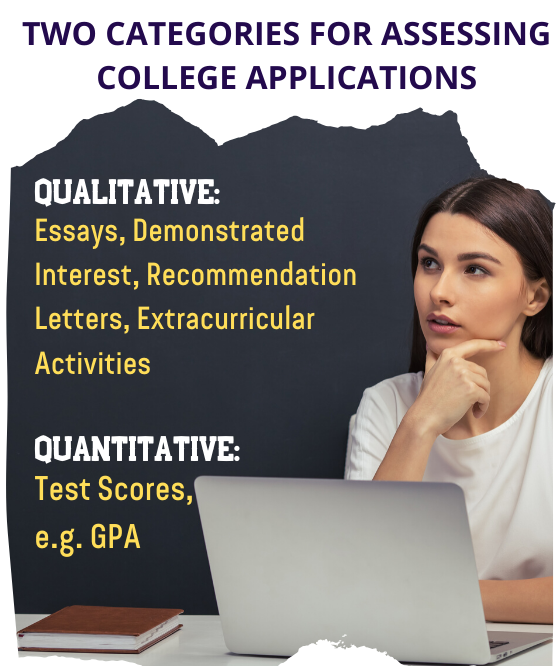
There are two categories that the admission officers consider when assessing applicants: the quantitative factors such as test scores like GPA and the qualitative elements like essays, demonstrated interest, extracurricular activities, and recommendation letters.
Recommendation letters are one of the many components of college applications. They are crucial to boosting your academic profile. With a Recommendation Letter, college admission officers gain insight into who you are as a student from the perspective of people who have worked closely with you, such as your teachers and counselors. Get quality recommendations and submit them way ahead of time.
Ignoring Instructions
Failing to follow instructionsto the letter will have admission officers label your college application as alow- to non-priority. It may even be rejected! Remember that they receiveapplications and deal with hundreds of applicants daily.
Fill out all the information andcomplete all documentary requirements, precisely the way college admissionofficers would expect them. For error-free applications, carefully read througheach application and ask for reliable help if you have questions and inquiriesin their Common App's Support Center.
Understating YourAccomplishments

College applications wouldhave you present yourself in the best way possible. If you were president of anhonor society, don't just say that you were the "leader of a studentorganization." Instead, explain you were president of the prestigious NationalHonor Society. Talk about how it required a lot of responsibility, themembership, and the organization's milestones under your term.
Use the Common App's ActivitySection to talk about your academic accomplishments. Some colleges will checkwith the school to confirm your participation in any clubs, organizations, andactivities listed on the applications.
Accurately stating yourachievements is not being arrogant or self-absorbed. It's a plus if you're as high-achievingand as motivated as they want their students to be. Don't be shy!
Making Generic Essays
The Common App gives studentsa choice of essay topics. An impressive essay generally contains a strongopening, well-organized content, and a powerful closing. Colleges don't get muchfrom a generic essay and would prefer ones that follow the instructions anddraw their attention from start to end.
Here are tips for writing theessay that admission officers will think are worth their time:

- Resist the temptation to pick a topic right away. Consider
your key experiences and achievements.
Include enough background information about yourtopic.
Pay attention to structure. Don't just ramble; makesure you know what to say paragraph by paragraph. Use the right adjectives todescribe the many elements in your essay.
Neglecting to Proofread
Proofreading collegeadmissions essays and other written materials is an essential but oftenundervalued step in the college application process. Students may not thinkthey'll be judged on anything other than the merit of their application, but yourpromptness matters!
It is a good idea to make adraft of the application before creating your final copy. It also helps to haveother people like your guidance counselors, teachers or family members lookover your application to see if you missed anything. Don't count on the spellcheckeralone.
Bear in mind, however,that not everything that is spelled correctly makes sense.The admissions team will notice applications with grammar or punctuation errors, so it pays to go over your piece again before submitting it. Beat the deadline but allow a lot of time to complete it. In the end, go over your college application multiple times, and look for different things each time. Review your application one time, making sure it sounds as smart and college-ready as you are.
Procrastinating
Deadlines are non-negotiable inthe college application process, and procrastinating with the Common App is ano-no. Plan and take the time with your application to make a good impression onthe admissions committee.
Get the process started on August 1st rather than December 31st. Falling behind will result in missed deadlines, sub-par work, and lost opportunities for financial aid or direct admission to specialized programs. Failing to prepare for and delaying your college application deadlines can undo the hard work you have put into completing the process.
The personal essay, forexample, is arguably the most time-intensive part of this whole process—so takethe time to complete it.
Starting well in advance ofdeadlines gives you these benefits:
Gives you the maximum amount of time to gather all the necessary documentation and complete a compelling essay or two
Make last-minute adjustments to polish your applications
Avoid last-minute technical difficulties
Did you know that collegestrack when students send applications, and therefore your promptness (orotherwise) impacts your chances of success? Applying on the due date of theapplication may indicate to the admissions officers that you are not interested.It also gives them the impression that their school is your low-priority choice.
It is a challenge to meet thedeadlines and documentary requirements of each college you're applying to, but preparationand organization can simplify the process tremendously. To keep track of it all,build a comprehensive spreadsheet or chart of the tasks you need to completefor each school.
Make the Most Out of the Common App

The Common App is a drivingforce in American higher education, helping alleviate the overwhelming workloadthat students need to manage when applying to colleges. As a tool for pursuing"access, equity, and integrity in the college admission process," the CommonApp levels the playing field for prospective college students who do not have thesame opportunity as the others to enjoy the "value, attainability, andaffordability of a college degree."
The Common App also enables universities to accept students from across the nation and even internationally, from varying backgrounds.
The Common App is a "proven engine for advancing college access" and has had a "transformative effect" on the admissions process. Make the most of it by knowing the basic dos and don'ts! You need to get an early start, take sizeable tasks and break them down into smaller, easier to manage ones, create deadlines and stick to them, and, most of all, hold yourself accountable to them. It doesn't hurt to have a plan and be organized, too!