Notetaking, a good habit, keeps college students' courses and lessons organized. On-campus and distance learners write down notes logically according to importance, relevance, and priority.
Students write at an average of approximately 0.3 to 0.4 words per second; however, the instructor speaks at a pace of around two to three words per second. Unless your professor chooses to talk a little slower or you have above-average shorthand skills, you need the right processes and methods for taking notes.
Explore our in-depth feature on notetaking! Use these pagejumps for easy navigation:

Advantages of Effective Notetaking Techniques
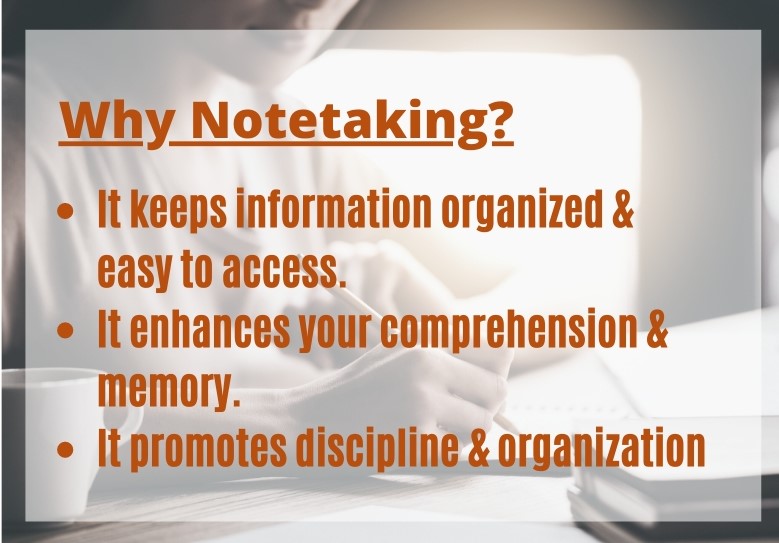
Messy lecture notes are a pain to read; oftentimes you lose the crucial information you need for an exam or research. For this reason, notetaking is an essential part of every college student's journey. Not only does effective notetaking enhance your comprehension and memory; it also promotes discipline and organization, and raises your chances of succeeding in college!
Notetaking techniques impact the way you access an overwhelmingamount of information. These are some of its benefits:
A series of clear and well-formatted notes does away with wordy, insufficient, and vast content.
Well-organized notes make presentations easy.
Generally, notetaking eliminates the feeling of distraction and sleepiness in online classes.
It improves your retention and reading comprehension.
It promotes active listening and engagement in class, so you stay alert and proactive.
According to a study,learners who traditionally write notes perform better in exams than those who doit digitally. Manually written notes tend to be recalled at a faster rate,especially with a memoryrehearsal. As such, well-organized notes are vital in your exam preparations.
It is to a student's advantage to learn notetaking techniques before going to college. The perfect way to prepare for post-secondary education is to acquire college-level notetaking and organization skills.
What to Write
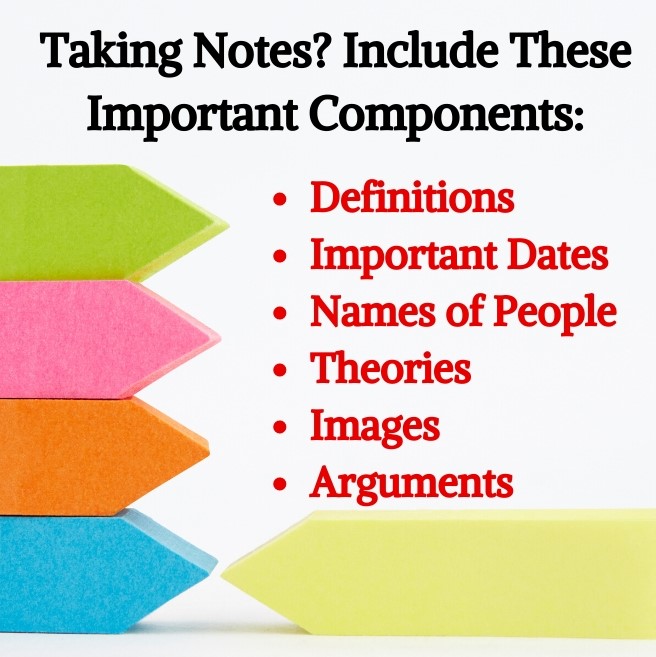
Notetaking is a skill to master. When taking notes, focus onnew, meaningful, and relevant information. Here are the basic parts of a collegelecture that you should focus on when taking notes:
Introductory statements that generally include an outline of the topic overview
Signal phrases and statements such as "A major cause of…", "In summary," or "There are five main…"
Repeated concepts or highlighted words
Gestures that emphasize specific parts of a statement
Final words, observations, and conclusions
For an effective notetaking strategy, focus on these components:
DefinitionsThese are the main points in every discussion. They arerepetitively described or mentioned in every context of the lecture. Unless youare confident that you already know the definition of a specific term, write itdown.
Important DatesImportant dates paint a chronology of events to help you comprehend the context of an occurrence. For example, knowing Albert Einstein's date of birth enables you to identify his milestones in relevance to the trends during that period.
TheoriesAny theoretical statements or frameworks must be written inyour notes. Most of the time, these are the main points in every discussion.
ImagesA short description or statement of a painting or image can helpyou memorize and understand ideas better.
Arguments and DebatesTake note of the pros and cons to help you compare ideas andcreate a precise thought process.
Names of PeopleAssociating names with key ideas and events help you better recall them.
Digital Notetaking
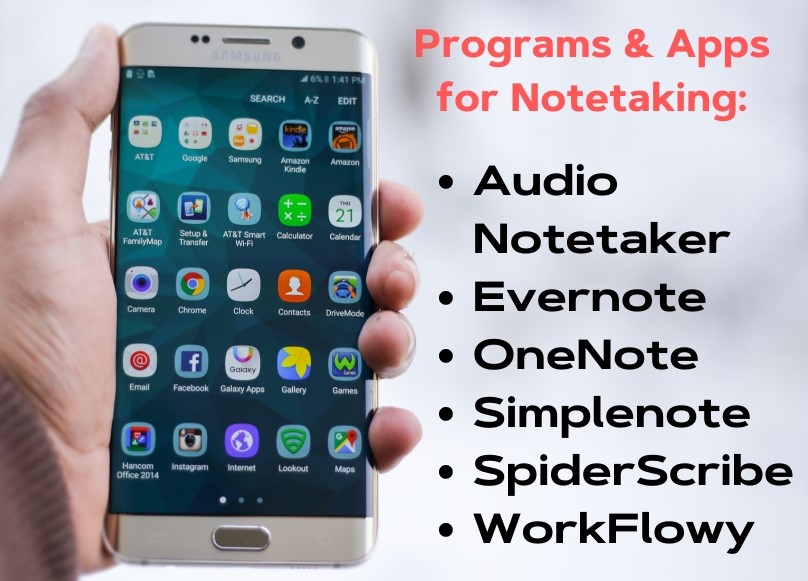
While it has its downsides, notetaking using a laptop ortablet—especially those with excellent speed and memory—makes the task convenient.Here are the software applications and mobile programs that students,particularly distance learners, can use to create well-organized notes.
Audio Notetaker is a tool used to record audio from a lecturer or another virtual source such as YouTube or Skype. It is only built for personal computers and features customized outputs, real-time note-taking, and screen captures. Also, it has presentation tools and advanced playback features for added versatility.
Evernote is an iOS-based tool that, for no extra charge, records audio and scans handwritten notes.
OneNote organizes data and stores it for unlimited use. It is a customizable application as part of the Microsoft Office Suite. It has a "data citation" feature for every snippet of information that is copied from the Internet.
Simplenote's compatibility with several applications allows for seamless syncing or sharing of notes. All notes recorded online or on your mobile device automatically sync with Simplenotes.
SpiderScribe is an app integrated with Flash. It is a digital mind-mapping platform that allows importing and embedding data such as images, maps, and videos. A single user can create up to three maps for free.
WorkFlowy is a word processor, but you can customize and turn it into a useful notetaking app. You can nest pages, put them together in a bullet list, and access them as systematically organized information. You can select the data you wish to view and search for information easily.
Types of Notetaking Techniques
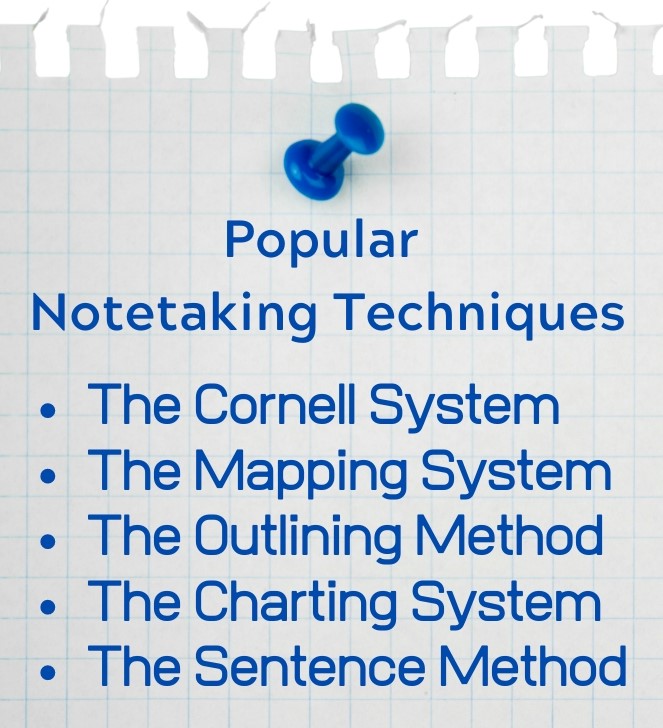
There is no right or wrong format to use when taking notes,but remember that the method you use can significantly impact the way you learnand process information.
Don't be afraid to try the best technique that works for you!Here are five types of notetaking techniques you can explore:
The Cornell System
The Cornell Method is an easy but powerful system thatpromotes better memory recall by organizing lecture notes into easy-to-remembersummaries. It holds together the main points, the outline, the essentialdetails, and the study cues in a single place.
Advantages:
- Distance learners can pull out major points,
concepts, or ideas.
Lecture notes are neatly summarized,well-organized, and easy to review.
Divide your paper into three parts. The largest sectionshould hold the most crucial information. The narrow column on the right side shouldhave the "cues" or questions that you can use to review the notes. Write a summaryof your insights on the remaining part of the paper.

The Mapping System
The Mapping Notetaking System is a visual method of organizinglecture notes and identifies the relationships between concepts. It ispresented as flowcharts, T-charts, charts, timelines, graphic organizers, VennDiagrams, and tables that are suitable for visual learners.
Concept Maps are ideal in lectures that explain the relationshipbetween ideas, examine information, and compare or contrast them.
Advantages:Compatible for visual learners
Helps online students easily recall ideas
There isn't a definite way to create concept maps. You cantake a piece of paper, write the subject information on the middle part, and drawlines to point the subtopics that originate from the main idea. This structureshows you how the topics are linked.
The Outlining Method
The Outlining System of Notetaking utilizes headings andbullet points to arrange concepts. This process applies to subjects thatinvolve numerous details. It works best for students who learn and recall informationbetter with a simple, straightforward, and clean notetaking structure.
Advantages:Well-organized lecture notes
- Presents the relationships between main topics
and subtopics
Begin by selecting four or five main points and write their subsections.Whether you utilize bullet points or the Roman Numerals, outlining helps youdetermine hierarchical relationships between concepts. For example, in ascience lecture, you can write the name of notable physicists and below them, theirdiscoveries or scientific milestones. Under each item, write a shortdescription. Outlining also works when you take notes directly from a book.
The Charting System
The Charting Notetaking Method categorizes numerous conceptsto highlight their differences.
It is useful for writing facts and statistics and making chaptersummaries to review for exams.
Advantages:- Highlights essential pieces of information for
each subject
Organizes facts so that they are easier toreview
Reduced writing time
Create columns on a piece of paper and label them by category.Write the information on the proper column and under the right category.
The Sentence Method
The Sentence Note-Taking way is merely writing down pertopic as a note sentence. This system works perfectly for the fast-pacedlecture, where a lot of topics are being discussed. It is considered one of theeasiest methods of writing down notes, important for distributing which piecesof information from a lesson is significant by swiftly covering information andessential details.
Advantages:- Helps online students tackle an abundance of
information
Simplifies information for students to reviewand study easily
Arrange your lecture notes using headings. This is ideal ifyou are a visual or auditory learner. You can pair this technique up with the Cornellsystem.
Making The Most Out Of Your Notes
Have you identified which note-taking method works best foryou? If yes, how do you get the most out of your lecture notes? There are threedifferent ways to boost your class notes:
Recall and review a small part of your notes daily. Avoid cramming right before your scheduled exams.
Review your lecture notes within the first 24 hours after your discussion. You have better chances of remembering them within this period.
Use your notes when completing assignments or doing research.
It's easy to talk about notetaking methods, but the biggest takeaway is that the technique you choose should help you quickly find and understand information.