It is typical for incoming college students to be drawn to large state academic institutions that impress with their national recognition and offer a vast range of learning resources. However, when the academic institution is located in a different state, students find themselves burdened by expensive tuition. Many are unable to pay for out-of-state university tuition and decide to settle for in-state colleges.
Attending an online college in 2020 is one of the best times to do so. With the future uncertain due to social instability and Covid-19 threatening to affect fall enrollment in schools, studying online is one way to prepare for a more certain future. Attending college should be about preparing yourself for a career you wish to pursue. These online schools will offer the big school in-state price to all online students, making them an affordable place to prepare for the future by studying online.

What the Terms "In-State" and "Out-of-State" Mean
"In-state" students are residents of the state where their university is located. State taxes subsidize the tuition. Out-of-state (OOS) students are non-residents of the state where they attend classes, so their tuition is not subsidized and they pay more.
In-state tuition fees are cheaper than out-of-statetuition fees.
In-state and out-of-state tuition rates generally apply topublic colleges and universities. Public colleges depend on tax revenueallocations from the state government to subsidize their operations. Publicschools set a differential rate structure based on, among other things, thegovernment funding that they receive.
A portion of the federal tax, which Americans pay regardlessof where they are, is used to fund public academic institutions. Stateresidents are then provided subsidized tuition in the form of in-state tuitionfees. Students living outside the state, as well as international students, arerequired to settle out-of-state tuition.
On the contrary, private educational institutions rely ondonations, tuition fees, and other forms of funding. There is no activeinvolvement of the State Government in the funding of these schools, which iswhy private colleges or universities have higher tuition and fees than publicacademic institutions.
Public universities typically have lower rates than privateacademic institutions, with the latter's students practically paying the schoolto operate. Simply put, public universities set differential rate structuresfor in-state and out-of-state students; private academic institutions providethe same rate structure for all.
Students with permanent residence status pay their collegeor university in-state tuition. Students attending a public state school thatis not in their home state must pay out-of-state tuition. This status is alsoapplicable to international students.
The Chronicle of Higher Education explains that the differing rates between in-state and out-of-state tuition fees contribute significantly to the state economy. The generally cheaper in-state tuition rates are the better prospect for state residents who, in turn, will pursue a career or establish a business close to their home.
Why In-State Tuition is Cheaper than Out-Of-State

Out-of-state learners pay lower tuition because they do not pay taxes to the state where their school is headquartered or located. On the contrary, in-state students indirectly fund the college or university their entire lives. With cheaper tuition, states are able to account for the tax contribution they already paid to support their state's school, as well as reward residents for their contribution.
When you consider this factor, the difference betweenin-state and out-of-state tuition fees is not much of a big gap. However,settling a school's out-of-state tuition fees and other related expenses canstill be a burden to several families. Fortunately, there are numerous ways forout-of-state students to avoid paying higher tuition fees.
Proving Residency for In-State Tuition
In private universities, students pay the same tuition regardless of residency. However, by moving to a different state to pursue post-secondary education in a public learning institution, they will have to pay out-of-state tuition at least during their first year. Upon proving residency for a certain number of years, they may become eligible for in-state tuition rates.
The requirements to be considered a resident in a state candiffer widely by state and university, which can make the process challenging. Standard dictates, however, that to bequalified for in-state tuition, students need to establish a physical presencein the state, financial independence, and intent to stay. After that, thesemust be proved to the students' chosen college or university.
- Financial
Independence
– Learners must prove their financial independence. Theserequirements differ from one institution to another; however, it generallyinvolves students filing their taxes. A number of colleges or universities willnot allow students to receive any assistance from their parents, while someschools permit parents to pay part of the tuition. There are universities thatwon't grant in-state tuition fees to learners who receive financial aid. Intent– Learners must show that they want to reside in a state for reasons beyondjust wanting to enroll in higher education in the state. Students can provethis case with a voter registration card, new driver's license, letterexplaining their intentions to stay in the specific state, and pay stubs.
PhysicalPresence – The majority of the states require students to reside in thestate for at least one year before establishing residency. In some instances,students can't go home during summer vacation. Methods to prove this include aproperty with students' names on it and regular bank statements indicating thatthey are spending money in the state.
Students who are considered "dependents" must have at least one parent living in the state for a year. Students with spouses, on the other hand, must be a state resident for least a year at the start of the semester. Some states set a few more requirements for residency and the minimum age for independent status.
Pertinent Documents Proving
Residency
Residency requirements may be recognized by the state boardof higher education. The authority to assess whether a student is eligible canbe delegated to the college or university. The learning institution must haveevidence that the family had established state residency not withthe primary intention of benefiting from in-state tuition rates.
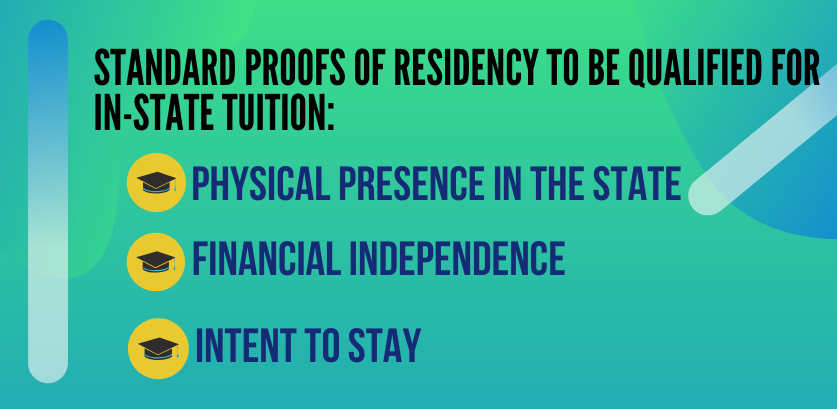
Whether a learner is eligible for state residency is decided upon by the Office of Admissions or Registrar at each college or university. It is ideal to have at least two government-issued documents that highlight state residency and this must be dated with at least a year prior to the first day of classes. The following documents may include:
Documents proving enrollment in the public college within the state.
A Declaration of Domicile filed with the County Clerk at the beginning of the residency
Federal and State Income Tax Returns that indicate an In-State Residential Address
Voter Registration Card
Selective Service Registration/Vehicle Registration in the State
Driver's License issued by the State
Avoid Paying Out-Of-State Tuition
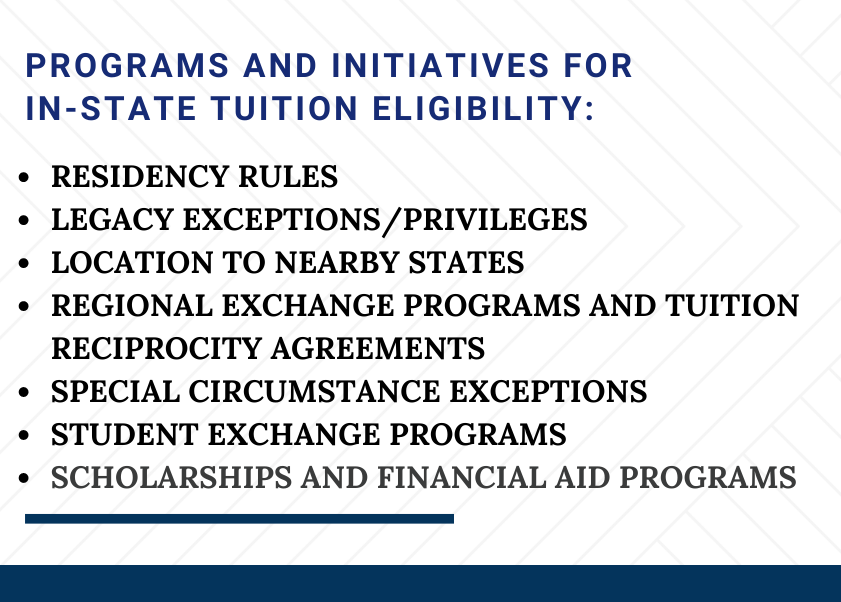
Prospective students who are seeking to pursue post-secondary education but cannot afford out-of-state tuition fees can take advantage of several programs and opportunities to pay in-state tuition fees.
Here are some of the programs and initiatives that can makeout-of-state students eligible for in-state tuition:
Residency RulesStudents can become a resident of the state where they are pursuing a college education. Residency requirements and policies in schools and states differ, so it pays to evaluate your eligibility. Typically, dependent a student's status of residency is based on where their family resides, not where they live for post-secondary studies. Most undergraduates are not considered financially independent; it's challenging for them to qualify for domicile tuition in a different state.
LegacyExceptions/PrivilegesSeveral colleges provide legacy exceptions. Are you considering enrolling in the same school that their parents attended? You may be eligible for in-state tuition fees as an out-of-state learner if your online school honors academic legacy. For example, the University of Missouri may lower tuition rates for legacy students who excel academically.
Location to NearbyStatesFlexible residency requirements apply to students who live near state lines and want to venture for post-secondary education. For example, Minnesota has an agreement with a number of neighboring states such as North Dakota, one institution in Iowa, Wisconsin, the Canadian province of Manitoba, and South Dakota as reported by the U.S. News and World Report.
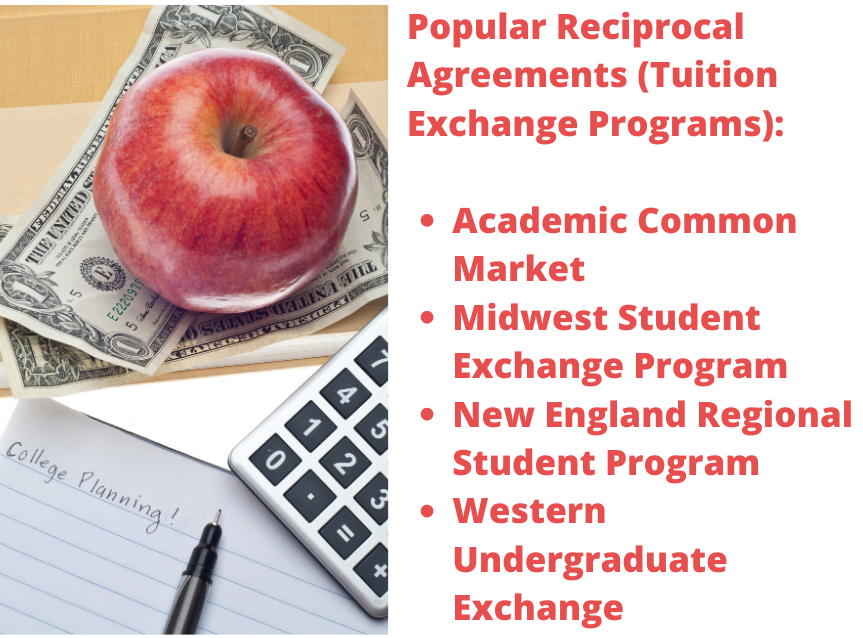
Regional ExchangePrograms and Tuition Reciprocity AgreementsExplore regional exchange program initiatives for reducedout-of-state tuition. Here are the four regional programs based on academiccommon market arrangements:
Midwest Student Exchange Program – Member states include Illinois, Indiana, Kansas, Michigan, Minnesota, Missouri, Nebraska, North Dakota, Ohio, and Wisconsin
Western Undergraduate Exchange – Member states include Alaska, Arizona, California, Colorado, Hawaii, Idaho, Montana, Nevada, New Mexico, North Dakota, Oregon, South Dakota, Utah, Washington, Wyoming, and the U.S. Pacific Territories and the Freely Associated States
Southern Regional Education Board Academic Common Market – Member states include Alabama, Arkansas, Delaware, Florida, Georgia, Kentucky, Louisiana, Maryland, Mississippi, Oklahoma, South Carolina, Tennessee, Texas, Virginia, and West Virginia.
Other reciprocity arrangements:
Students who live in border counties may be eligible for in-state tuition rates at the nearby state. The Border County Higher Education Opportunity Program permits some Oregon residents residing in counties that border Washington State to pay in-state tuition fees when attending Washington State schools.
SpecialCircumstance ExceptionsHigher learning institutions may make exceptions. They may,for example, charge in-state tuition rates for students with parents in themilitary.
Student ExchangeProgramsLike the state-based alternatives, student exchange programsare arrangements reached among academic institutions. Generally, they permitstudents to enroll in any school in the consortium either at in-state tuitionfees or at the rate they would receive by completing classes at their homecampus.
For instance, the National Student Exchange allows students to enroll in classes at a hosting institution for reduced rates for up to one year. Learners have the option to change between schools throughout their academic journey.
The Consortium of Universities of the Washington Metropolitan Area has the same cross-registration program. Learners can complete classes at member schools while paying the same tuition fee as they would at their primary school.
Scholarships forOut-Of-State Students and Financial Aid ProgramsThe majority of colleges are willing to offer tuition breaksto lure high performing students to their schools. Since their academiccapabilities enable them bargaining power, these learners can be eligible forin-state tuition fees at some state schools that will provide the benefit.
The following are some of the schools that haveinstitutional scholarships for out-of-state learners that are merit-based:
University of Alabama
Kennesaw State University
Mississippi State

Becoming Eligible for In-State Tuition
It is not uncommon for online students to be enrolled in adistance learning program run by an out-of-state academic institution. Otherstudents, on the other hand, may need to enroll in a different state throughoutthe academic year, particularly over the winter and summer terms.
Here are six of the best tips to enjoy in-state tuitionrates as an out-of-state online student:
Seek PermissionSome school policies require students to pursue off-campus education prior to admission. This prevents students from completing a program without completing a specific class or course requirement.
In several cases, it is the academic department chair of thehome college or university that can provide the course equivalencyrequirements. You will need to ask in advance because some schools keep a listof pre-established course equivalency requirements.
Verify Concurrent Enrollment PoliciesStudents who have full-time matriculated status must check their college's concurrent enrollment policy before admission to a distance learning program in another state. Due to the federal data reporting standards, it can be quite complicated when a full-time matriculated student in one school also becomes a part-time non-matriculated student in a different state.
Seek the approval of your administrator prior toconcurrently enrolling in a different state. If not approved, your main schoolmight not accept the credits you obtained for degree completion.
Assess Financial Aid ImplicationsStudents who receive financial aid at his or her home academic institution are usually not eligible to receive financial assistance from a second college or university during concurrent enrollment. With that said, learners must pay tuition fees out of pocket for the extra online fees. The only exception that is considered is when the student is enrolled in an established dual-enrollment program.
ConsiderCultural and Logistical Diversities
Despite being in a virtual learning environment, the differences between academic institutions are evident. As a student, you will be immersed in two different sets of policies, grading systems, cultural norms, software requirements, and course catalogs. Students must be able to work his or her way out of such differences.
Check out State Authorization Reciprocity Agreements (SARA)This is a voluntary standard initiative designed for convenient procedures for enrollment in post-secondary online courses at colleges or universities across member states, territories, and districts. Students who plan to pursue an education in a state other than where they currently live are encouraged to visit the SARA website.
Can Out-Of-State Tuition be Waived?
Tuition Waivers are essentially scholarship programs but are granted based on gratitude or need and other merits instead of academic excellence and athletic capacity.
The majority of tuition waivers are given based on financialneed. Several of the most expensive and reputable schools in the countryprovide generous tuition waivers to low-income households. Other well-knowntuition waivers are granted to families with a military background or publicservice.
Numerous schools provide similar benefits in gratitude todependents of teachers, firefighters, police officers, and other publicservice-related professions. In addition, students may be granted waivers as arecent immigrant, first-generation college student, unemployed adult, fosteredchild, or Native American.
Public academic institutions provide a few ways to waiveout-of-state tuition fees. With post-secondary education becoming moreexpensive, the discounts add up to significant savings for incoming learners.Academic capabilities or school choices can result in prospective studentsreceiving in-state tuition fees. Some of the ways to obtain discounted tuitionfees require advanced planning.
Pursue the ObscureOne of the methods to get out-of-state tuition fees requiresenrolling in schools in locations that need young people. Specific schools arein places with reduced young adult society. They provide in-state tuition feesto non-residents to make the location more attractive to potential learners.One thing to consider – despite discounts having been attractive, severalschools are located in remote areas, rural and rank poorly when compared toother well-known institutions.
Ace Standardized ExamsMethods to waive out-of-state tuition include doing well onstandardized examinations and having a reputable academic background andcredentials. The test scores from SAT and ACT college entrance tests areutilized as an indicator of academic performance for incoming collegeapplicants. Applicants with high scores are perceived to be excellent students,which aids in strengthening the student body and increase student quality.Prospective students must have a minimum GPA and be endorsed by an admissionsteam staff for this waiver type.
Purchase or Rent aHouseResiding in or near the preferred school offers a method towaive out-of-state tuition fees. Depending on the nature of the program, someacademic institutions offer in-state tuition rates to learners residing in thearea for at least a year prior to enrollment. Some schools consider learnerswho are living on-campus and paying rent for at least half a year as fulfillingresidency requirements. Residing in a house on the border of a specific stateoffers an opportunity to earn resident tuition fees in the adjacent state.
Land the Right CareerEmployment status offers an additional way to waiveout-of-state tuition fees. Being employed in specific organizations offersemployees and their dependents with waived out-of-state tuition fees. Activeduty military personnel headquartered in the state where the college oruniversity is located are qualified. Academic institutions provide waivers tointernal employees and their dependents. In some instances, instructorsemployed in the public school system where the institution is headquartered arealso qualified for in-state tuition rates, regardless of how short theirduration of residency in the state.
Earn MeritScholarship ProgramsLearners who have achieved good scores in the ACT or SAT andhave maintained a high GPA may have opportunities from colleges or universitiesthat cover the gap between in-state and out-of-state tuition rates. Thesescholarship programs are generally renewable and, in some instances, learnersmay have their full tuition covered.
Explore State Tuition Exchange ProgramsNumerous states participate in reciprocal agreements with nearby states. Tuition exchange programs provide non-resident learners the opportunity to enroll in participating out-of-state academic institutions at a similar or reduced rate that they would pay at public, in-state institutions. In addition, students aren't limited in terms of choosing a major, unlike the regional agreements.
Fulfill MilitaryDutiesAnother method where students can save on tuition fees atout-of-state institutions is to serve in the military. The majority of theseacademic institutions will permit active-duty members and veterans to enjoyin-state tuition fees. Regardless of where learners attend college, it iscrucial that they have an effective financial aid program available and takeinto consideration the total cost of attendance. It may seem more adventurousto travel away from home but learners who acquire huge amounts of student loandebts to finance their educational expenses may regret their decisions in thelong run.
Does FAFSA cover Out-Of-State Tuition?

Yes, FAFSA covers out-of-state tuition. While seeking assistance with students' out-of-state tuition is a bit challenging, there are several schools around the country that make it easier.
Regardless of where the students want to pursue higher education, they may be qualified for some federal aid or financial assistance through the U.S. Department of Education. It is free and convenient to submit the FAFSA. Through this program, students will be granted need-based federal grants, work-study funds, and/or loans. Students may check out the FAFSA4caster to get an estimated amount on how much federal aid they may be qualified.
Affording Out-Of-State College Fees
The biggest drawback of enrolling in an out-of-state public college or university for several students is that they will be paying more than their colleagues who are residents of the state. The difference can be sometimes negligible, but some states add a higher amount for out-of-state students.

But this doesn't have to be the case! Here are certain ways to reduce your out-of-state tuition and expenses:
Talk to the Collegeor University's Financial Aid OfficeStudents who have a specific college or university in mind and are worried about the cost of attendance as out-of-state learners are encouraged to reach out to the school's financial aid office. In several cases, state schools have merit or need-based aid that they can grant specifically to out-of-state learners. Not everyone will lodge an application; however, it is one of the best ways to reduce tuition expenses.
Enroll in a StateSchool in an Academic Common Market ProgramA number of states have come up to offer reduced tuitionrates for out-of-state students. If they reside in one of the states covered bythe organization, they can pay a reduced tuition rate to attend post-secondaryeducation.
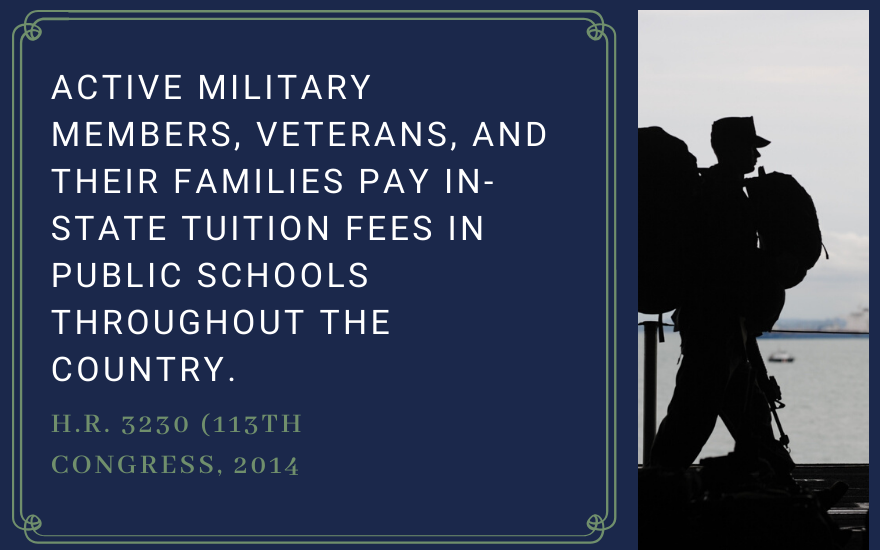
Enjoy Benefits asActive Military Members and VeteransIn the past, only some states provided in-state tuition toactive military members and their dependents. In 2014, H.R. 3230 was approvedas a law to allow active military members, veterans, and their families to payin-state tuition fees at public schools throughout the country.
A lot of preparation and planning is needed to become a state resident. Dependent students and their parents or guardians must reside in the state at least one full year before considering themselves as a resident of the state. Unluckily, attending one year in college of the preferred state is not counted. If students and their families are relocating to the state of their preferred school, they must ensure to have the proper documentation to prove the status of their residency such as obtaining a driver's license in the specific state, paying taxes and registering to vote. It may seem like a daunting move but depending on the student's circumstances, it could be a fulfilling decision and could save them in terms of academic expenses.
Find WaiversSome academic institutions have tuition waivers andscholarship programs to attract top-performing out-of-state applicants toenroll in their academic institutions. Some colleges or universities offerwaivers or scholarship programs to learners who reside in a nearby state orlearners whose parents were enrolled in the institution.
Tuition in Online Colleges

The concepts of in-state and out-of-state tuition are alittle more complex in online degree programs than in traditional schools. Studentsmay be surprised to know that even distance learners often have to payout-of-state tuition. This doesn't seem to make sense because online students don'teven have to actually physically travel or stay out-of-state. But the rationale is still the same: inexchange for state tax funding, public academic institutions that offer onlinedegree programs charge in-state tuition to in-state students.
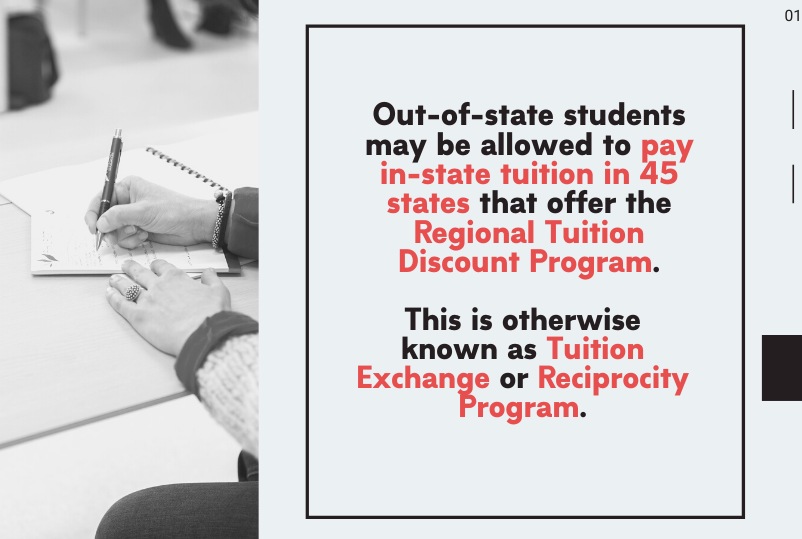
According to the U.S. News and World Report, the tuition in for-profit virtual colleges are cheaper than out-of-state tuition fees in public universities or private colleges. Whether a prospective learner is charged out-of-state or in-state tuition depends entirely on the type of the online program and the school's policies. There are 45 states that share reciprocal online programs with neighboring states, allowing out-of-state students from both states to enjoy in-state tuition.

Just as on-campus students, online learners seeking to payin-state tuition will have to prove residency. In terms of applying forin-state tuition, the same processes apply to both conventional students and onlinelearners. Students enrolled in online schools operated by state-funded collegesand universities must demonstrate that they live in-state. This, however, canbe quite tricky because the eligibility rules vary from one public school toanother. Different states and schools have varied requirements and, mostly, theyrequire living in the state for a specific period of time.
With that being said, not all public academicinstitutions make out-of-state online learners pay out-of-state tuition fees.It is important to remember that, unlike on-campus students, distance learners donot utilize any facility in an actual classroom. Online schools usually offer discountsto distance learners or charge in-state tuition fees regardless of theirresidency status.
Wait, Are Online Degrees Respected?
Two types of colleges grant online degrees, namely online-only institutions and on-campuses with online degree options. In 2012, approximately 86% of traditional residential colleges provided college courses through distance learning. More than one-third of them delivered the degrees 100% virtually.

Distance learning is no longer the future. It is already happening now! Gone are the days when obtaining a degree or finishing post-secondary education is considered odd. Distance learning is gaining traction and maintaining a solid reputation among students of all ages. Online degree programs are no longer regarded as second class or inferior to their traditional counterparts.
Potential employers are embracing distance learning inrecord numbers. It is no longer mandatory to disclose that a degree was earnedonline—or hide the fact. Today, your previous schools attended—whether aChristian college, a secular college, or a public or private school—may beopenly discussed in job interviews. The truth remains, however, that theoverall academic reputation and the quality of education of previously attendedonline schools matter to prospective employers.
Recommended Schools
Are There Online Schools That
Charge the Same In-State and Out-of-state Tuition?
Absolutely! We list the 24 online schools that charge theirdistance learners a flat rate for tuition and fees, notwithstanding students'residency status:
Mayville StateUniversity
Mayville State University is one of the member schools of the North Dakota University System and has approximately 800 students. Mayville State utilizes Blackboard learning management system to host online courses for its distance learners. Learners enjoy access to academic advising, online writing assistance, disability services, online tutoring, and an online library with access to numerous academic databases as well as online librarians available through Skype or over the phone.
Mayville State and Dakota College atBottineau has established a memorandum of understanding or partnership forlearners who wish to remain in the Bottineau area while earning a bachelor'sdegree program. The partnership permits learners to complete their initial setof coursework through Dakota College and then apply for enrollment to MayvilleState University. Moreover, learners have the opportunity to complete theirrequirements for a bachelor's degree in Mayville State while staying in theBottineau area.
Mayville State provides low tuition fees and expenses basedon the program level and type of degree. All in-state and out-of-state learnerspay flat-rate tuition fees. Undergraduate students pay $305.00 per credit hour,while graduate students pay $335.60 per credit hour. In addition, students paymiscellaneous and other expenses on top of the per-credit tuition expenses.Mayville State provides financial aid opportunities for learners who needassistance in paying the cost of their educational expenses throughscholarships, grants, loans, federal work-study programs as well as tuitionbenefits and discounts.

Western Governors University has earned accreditation as a distance education academic institution with students in 50 states and several international military bases. The university has several undergraduate and graduate degree programs in numerous areas of study such as business, education, healthcare, information technology, and engineering. WGU is the pioneer in competency-based learning, an initiative that allows online students to complete courses once they have demonstrated mastery of the subject matter. With this, learners work in a fast-paced or accelerated format. Programs start on the first of each month, enabling learners the opportunity to start their program any time of the academic year.
WGU's Bachelor of Science in Software Development offers a strong foundation in application development, web development, and computer programming. It utilizes numerous industry-recognized certification programs from CIW and CompTIA into the curriculum. Learners may select from two tracks either Java, or C#. 73% of graduates complete this degree in 9-33 months, depending on their pace and timeframe of learning. Learners enroll in required core courses such as User Experience Design, Scripting and Programming-Applications, Software Quality Assurance, Business of IT- Project Management, and Web Development.
WGU's tuition and fees adopt a flat-rate basis. The more courses each learner finishes each term, the more affordable his or her degree becomes. The undergraduate program fee is $3,225 per term, while the graduate program fee is $3,540 per term. Both undergraduate and graduate levels have a resource fee of $145, and a program fee of $150 on top of the tuition fee. The university has a generous number of scholarship programs for eligible students. Financial Aid is available for qualified students.
Delaware State University provides a wide range of online degree programs at the undergraduate and graduate studies. Distance learners may select from undergraduate and graduate programs in numerous fields of study, including accounting, public health, general management, psychology, sports administration, business administration, social work, and public administration. The university utilizes Blackboard, a web-based learning management system that offers learners the opportunity to access courses online. DSU has three categories of supplemental courses delivered utilizing the Blackboard platform namely blended learning courses, online distance education courses, and web-enhanced courses.
The majority of the undergraduate programs need 120-credithours or more; however, distance learners obtain their degrees in less thanfour years due to the flexibility and self-paced availability option offered bythe university. The university has numerous start dates throughout the academicyear, permitting students to start anytime they prefer.
Delaware University offers flat-rate tuition for allin-state students and out-of-state students.
Wesley College has three online graduate programs out of the several programs in different areas of disciplines. Graduates who are interested to enroll at Wesley College can select from the school's completely online master's degree programs. The Master of Arts – Sports Leadership and Master of Criminal Justice are just a couple of the programs that can be obtained completely online. A Restorative Justice concentration is available for prospective learners who want to be admitted in the criminal justice program.
The 100% online master's program needs 60-credit hours for program completion. All courses are accomplished online. Wesley College utilizes Moodle and BigBlueButton Live Classroom for all its distance learning programs and instructions. There is a specified system requirement for general Moodle use for online students. Technical support is readily available for learners who need technical assistance.

Saint Leo University offers a wide selection of online degree programs that assists distance learners in completing their degrees in a variety of disciplines. Opportunities for online students can select from Saint Leo's minors, associate, bachelor's, master's and doctoral degrees. Undergraduates can choose from more than 20 bachelor's degrees in accounting, business administration, criminal justice, education, liberal studies, psychology or sociology to name a few. Opportunities for graduate studies include majors in business administration, accounting, theology, cybersecurity management, health care management, criminal justice, instructional design, or software engineering.
A bachelor's degree program at Saint Leo requires 120-credithours for completion and generally take four years or less to earn. Professorsdeliver courses fully online and asynchronously, enabling online students toobtain their degrees at their own pace and convenience. Admission Requirementsfor all types include a non-refundable fee of $45. Prospective students musthave a cumulative 2.0 GPA and provide standardized examinations test scores.
Nova Southeastern University showcases more than 50 online degree programs varying from undergraduate and graduate program levels. Undergraduate learners choose from online degree programs in several areas of study such as education, health science, human services administration, psychology, recreational therapy, respiratory therapy, and speech-language and communication disorders. Opportunities for learners who want to pursue graduate studies include accounting, business administration, child protection, coastal zone management, computer science, criminal justice, forensic psychology, or health sciences.
Prospective students must comply with their admission requirements including an SAT or ACT test score and an official transcript of records to be admitted to the program. The set of coursework at NSU are accessible at any time of the day or night from anywhere with connectivity, allowing online students to earn their degrees at their own timeframe and convenience. The majority of the undergraduate programs need 120-credit hours for program completion. Distance learners have access to 24/7 technical support while studying and finishing their courses through the content management platform of NSU.
NSU has flat-rate tuition for all its distance learning programs. The rates or prices vary in each level of study.
University of Iowa

The University of Iowa is the oldest higher learning institution in Iowa and is widely known as Iowa's flagship public educational institution. The university provides 29 different online degree programs or certifications and more than 600 online courses. All distance learning programs have numerous start dates during fall, spring, or summer semesters. For prospective learners who want to have an on-site classroom experience for a change in environment, they may want to enroll and take courses at the Cedar Rapids or Des Moines campus locations. The major programs offered by U of I includes applied studies, writing & English, liberal studies, leadership studies, science & math, nursing, management, and political science.
Program requirements for completion and duration depend on the degree or certificate, students' availability, and course level. The online Bachelor of Liberal Studies requires 120-credit hours, consisting the 60-credit hours from two-year institutions or obtain an associate degree program. Learners must select a degree according to their interest and verify specific requirements in completing that degree as well as the program duration it takes to obtain. Online students can take an online set of coursework from the University of Iowa without enrolling in a program as a non-degree student.
Tuition Fees differ per online degree programs and the number of credit hours. The university offers a flat-rate tuition fee of $324/credit hour for its undergraduate students, while graduate programs cost $544/credit hour for both in-state and out-of-state learners. However, there are some degrees that have higher tuition rates and fees.
Des Moines Area Community College has a wide range of online programs in areas of study such as business, management & marketing, education, public & human services, health sciences, and transfer pathways. All DMACC distance learning programs are either Associate of Arts (AA) or Associate of Science (AS). DMACC On-Demand offers several fast-track online classes that distance learners can take through a fast pace learning format, permitting them to complete their set of coursework as quickly as five weeks. Undergraduates can choose the Associate of Arts in Business Administration- Entrepreneurship, offering them the business skills and knowledge that will equip them to become entrepreneurs. Aside from the business administration program, they can choose from DMACC's 15 other online associate degree programs.
Curriculum coursework and requirements differ per program. The online accounting specialist program requires learners to complete 64 credit hours and maintain a GPA of 2.0 or higher as well as receive a grade of C or above in all accounting specialist coursework. Learners enroll in mandatory courses including principles of accounting, financial analysis, business English, income tax accounting, and business law among other featured courses. The online criminal justice program, on the other hand, needs 64 credit hours and maintain a GPA of 2.0 or higher for the completion of the program. Learners take up core criminal justice courses including criminology, criminal & constitutional law, survey criminal justice agencies, and introduction to criminal justice. There are several start dates per academic year, and learners can begin on their selected program any semester. In addition, an accelerated format is available for distance learners who want to obtain their degrees faster than the normal schedule.
DMACC has flat-rate tuition of $186.00 per credit houracross all their associate degree programs, making the college as one of themost cost-friendly educational institutions around Iowa.

Pittsburg State University has a wide range of online degree programs in the undergraduate and graduate level of studies as well as a number of certifications. Students may select from Pittsburg State's undergraduate offerings namely Bachelor of Science in Nursing (RN-to-BSN), Bachelor of Science in Workforce Development, Bachelor of Science in Workforce Development- Supervision & Leadership, and Bachelor of Science in Workforce Development- Human Resources. These undergraduate programs utilize sequenced coursework that integrates theoretical knowledge and experiential learning programs.
Graduates students who want to obtain a master's degree atPittsburg State can select from more than 30 programs, including an MBA,history, sport & leisure service management, education, MSN-Nursing, humanperformance & wellness, and special education to name a few. Most programofferings at Pitt State include 30-33 credit hours of coursework that developsadvanced knowledge and competencies within their respective fields of study.
Program requirements and completion differ per specificprogram. Pittsburg State has flat-rate tuition across their online degreeprograms, enabling out-of-state and part-time learners to pay the same tuitionas the in-state students.
Wichita State University has a wide selection of associate, bachelor's and master's degree programs offered in flat-rate tuition, making this institution as one of the affordable choices in obtaining a degree program across Kansas. WSU has a generous transfer of credit opportunities, offering undergraduate students the opportunity to convey significant credits to an online bachelor's degree program.
WSU provides online bachelor's degrees in several fields of study such as general business, dental hygiene, education, homeland security, and criminal justice among other featured programs. WSU's learning format enables online students to establish a curriculum customized to their interests and aspirations and in sync with their future personal and professional goals.
The master's degree programs include criminal justice, arts leadership and management, and aging studies. Graduates can select from WSU's master's degree program offerings in several areas of study. Moreover, the university has a Doctor of Nursing Practice (MSN to DNP) that provides four areas of specialization namely adult/gerontology acute care nurse practitioner, family nurse practitioner, adult/gerontology clinical nurse specialist, and psychiatric/mental health nurse practitioner. The DNP program is accredited by the Commission on College Nurse Education and has received approval from the Kansas State Board of Nursing.
Undergraduate Tuition costs $325.87 per credit hour, whilegraduate costs $404.19 per credit hour.
Newman University has three undergraduate online programs and four graduate degrees in areas of study emphasizing business, education, and theology. Undergraduate students can select from the Business-Organizational Leadership, Interdisciplinary Studies, and Business & Strategic Intelligence. On the other hand, prospective graduate students can select from Newman's online Master of Theological Studies, Master of Education, Master of Business Administration, and Master of Arts in Theology.
All program offerings by Newman differ in program requirements and duration. The online bachelor's degree in organizational leadership program needs 124-credit hours for program completion. Distance learners take up courses in talent management, leadership, cross-cultural communication, mindful leadership, organizational behavior, and business ethics. The BS in strategic intelligence program also needs 124-credit hours for program completion; however, core requirements include intelligence collection, law and ethics in intelligence, the cold war, IT data visualization, and IT concepts of management information systems. The master's degree programs need 30-credit hours for program completion. Prior to the beginning of each class at the graduate level, online students are required to meet for an intensive weekend of instruction at the Wichita main campus. Distance learners who are not able to attend the said event are offered with online versions of the discussion, lectures, and other events.
Newman University's online programs are intended to meet distance learners' schedules and needs and begin every eight weeks. Online students take classes continuously throughout the academic year to assist them to accelerate their degree completion. The university utilizes Blackboard as their learning management system, permitting distance learners to access course materials, assignments, and other learning resources.
Flat rate tuition of $15,193 is implemented if enrolled in 12-19 hours. Graduate tuition per semester differs per major program requirement. Master of Science in Education costs $425/credit hour, Master of Arts in Theology costs $482/credit hour, and Master of Science in Social Work costs $595/credit hour. Newman University is one of the most affordable higher learning institutions in Kansas that offers several opportunities for financial aid programs, scholarships, grants, and discounts for eligible students. 99% of its first-time students have been provided with financial assistance in different forms.

Winona State University has an increasing selection of online learning programs for prospective students to select from. The university has 11 fully online undergraduate degree and certificate programs, offering distance learners the flexibility and convenience in obtaining a degree without compromising their personal and professional obligations. Winona State utilizes Desire2Learn Brightspace platform, permitting students to access courses as well as interact with their instructors and classmates online.
Winona provides a Bachelor of Science in Business Administration that emphasizes behavioral and technical approaches to managing today's rapidly-growing organizations. Online students are immersed in information and learning that assists them in managing resources at the individual, group, and corporate level of analysis. The program has required core required courses in international business, corporate finance, management of information systems, project management, operations management, and human resource development.
Tuition Fees vary per degree program. Minnesotaundergraduates pay $251.30 per credit hour, while non-resident undergraduatelearners pay $456.24 per credit hour. Full- time students under the eWarriorDigital Life and Learning pay a flat-rate tuition fee of $485 per credit hour.On the other hand, Minnesota graduates pay $415.80 per credit hour, whilenon-resident graduate students pay $627.35 per credit hour. Similar to theundergraduate programs, flat-rate tuition of $485.00 per credit hour iseWarrior Digital Life and Learning's payment fee. The university providesnumerous financial aid opportunities for qualified students, depending on theirenrollment status and major.
Bemidji State University is one of the member schools of the Minnesota State Colleges and Universities System that has more than 5,000 enrolled students and over 65 majors available. The university has seven bachelor's degrees, seven minors, and two undergraduate certificate programs as part of their offerings for online learning opportunities. BSU utilizes D2L Brightspace learning management system to deliver online courses through the internet. Online students enjoy access to BSU's student support services such as technical support, library resources, advising, disability services, and tutoring services.
One of the unique programs offered by the university is the Bachelor of Applied Management, a transfer-friendly program designed for distance learners who possess a two-year professional degree and are interested to pursue their professional career. This distance program comprises of 60-credit hours of core courses in principles of professional development, economic and costs analysis, quality assurance, markets and resource allocation, and mathematical reasoning.
The university has low tuition fees and expenses based onthe program level and degree type. All in-state and out-of-state learners payflat-rate tuition fees. Undergraduate students pay $274.40 per credit hour,while graduate students pay $432.15 per credit hour. Moreover, distancelearners pay miscellaneous and other expenses on top of the per-credit tuitionexpenses. The university provides financial aid opportunities for onlinestudents who need assistance in paying the cost of their education throughscholarships, grants, loans, federal work-study programs as well as tuitionbenefits and discounts.
University of Minnesota – Crookston offers comprehensive and academic programs to more than 1,800 enrolled students. UMN- Crookston takes pride in its online learning programs that are customized to meet the needs of adult professionals, providing the flexibility and convenience of online learning.
Undergraduate programs of UMN- Crookston includes a Bachelor of Science in Management, Bachelor of Science in International Business, Bachelor of Manufacturing Management, and Bachelor of Science in Sport and Recreation Management. Program requirements and length vary per program. Bachelor's degree programs typically need at least 120-credit hours for completion of the program.
UMN-Crookston has flat-rate tuition fees, permitting distance learners to pay the same amount regardless of the status of their residency. On-campus and off-campus learners pay $401.50 per credit hour across degree program offerings. All indicated fees do not yet include miscellaneous fees and other related expenses.
UMN-Crookston has a wide range of financial aid types where online students can qualify and lodge their application, offering them financial aid opportunities depending on their enrollment status and major.

Sierra Nevada College is a private, not-for-profit liberal arts academic institution that has an admission of more than 600 undergraduates and 500 post-graduates. Headquartered in the Sierra Mountains, the campus location enables unique programs in resort management and ski business. The college offers traditional programs in education, environmental science, fine arts, and humanities. One of the prominent highlights of online education in SNC is the 11:1 student-to-faculty ratio to make sure of a customized and extensive learning experience.
Founded in 1969, SNC has been renowned as one of the top accredited online colleges in the state. The college provides online students two bachelor's degree programs in psychology and global business management and two graduate programs in education featuring specializations in administration or English language acquisition and development. Instructors deliver online classes in six-week modules and online students are only required to take one or two classes at a time.
SNC enrolls first-time freshmen and transfer of students.Prospective online students interested in transferring can send in theirtranscript of records for a credit evaluation without submission of an officialapplication. In-state and out-of-state online students pay a reduced flat-ratetuition per-credit, in addition to a flat fee per semester. Distance learnerscan submit applications on a rolling admission basis throughout the academicyear. Prospective students typically receive an acceptance decision within twoweeks.
SNC's graduate degree programs have several start dates inJanuary, March, May, August, and October to deliver maximum flexibility forworking students. Prospective applicants for undergraduate degree programs donot pay for application fees; however, a $50 application fee applies tograduate students.
Southern New Hampshire is a private, non-profit educational institution that was established in 1932. It addresses the needs of more than 90,000 online students, considering it as having one of the biggest online programs in the United States. SNHU offers 239 online degree programs ranging from 17 certificates, 8 associate, 113 bachelor's, and 101 master's degree programs from a different of areas of study including accounting & finance, arts & design, business, criminal justice, education, engineering, health, liberal arts, math & science, psychology & counseling, social science, and technology.
All distance learners regardless of residency status pay aflat-rate tuition fee depending on the level of their chosen degree. Tuitionexpense can be lessened if learners have previous credits. SNHU has numerousonline resources to help learners in their online learning journeys such as24/7 tutoring center, academic advising, writing center, online library, careercounselors, and 24/7 technical support.
SNHU is one of the universities in the U.S. that do not needtest scores such as SAT, ACT, GRE or GMAT for enrollment. They have a varietyof online program options that accommodate all GPAs. In addition, noapplication fees upon admission to a specific program.

New England College is a private, liberal arts educational institution founded in 1946. The college is home to over 2,000 enrolled learners and provides a variety of degree programs. They are one of the top schools in the country that provides several distance learning degree programs across different areas of study such as accounting, business administration, communication, criminal justice, cybersecurity, humanities, liberal studies, professional studies, social sciences, and education.
Distance learners pay a flat-rate tuition fee, permitting in-state and out-of-state students to pay the same amount of tuition depending on their chosen degree program. Tuition on a per-credit basis differs per degree program across NEC's graduate programs. The college offers personalized attention with billing and financial aid opportunities to learners and parents from the time of initial inquiry through the completion of studies. In addition, NEC has utilized a Tuition Protection Plan initiative in assisting distance learners overcome financial losses that arise from unforeseen circumstances, forcing them to withdraw from a semester due to a valid reason.
Franklin Pierce University is a private academic institution that was founded in 1962 and was named after the 14th president of the country. The program curriculum of the set of coursework has a liberal arts foundation integrated with professional programs. The university offers 2 certificates, 4 associate degrees, and 9 bachelor's degrees, designed to provide online students the opportunity to obtain degrees with flexibility and convenience. The university aligns programs to associate online students from their programs to careers. Small class size due to the student-to-instructor ratio of 12:1 cultivates a deeper learning advantage. Undergraduate students pay flat-rate tuition for all degrees except the BSN program.
Program length and requirement vary per program. The Bachelor of Science in Nursing program is one of Franklin Pierce's popular programs. This 120-credit hour program is fitting for nursing students who have received an associate degree at another academic institution and transfer to Franklin Pierce as well as learners who generally enroll in the BSN program at Franklin Pierce. Online students take nursing major requirements including community health nursing, clinical decision making, leadership in professional nursing practice, health policy and the role of the professional nurse, and health promotion across the lifespan.
On the other hand, the Bachelor of Science in Criminal Justice builds upon online learners' expertise and explores the interdisciplinary study of crime, together with the function of the criminal justice system. This criminal justice degree needs 120-credit hours for program completion. Distance learners take courses in criminology, police work, race and ethnic relations, courts and criminal procedures, and social science research methods.
The majority of the graduate programs combine distancelearning with part or full-time study in on-campus locations and four academicterms.
Colby-Sawyer College is one of the new additions to incorporate online education for prospective applicants, offering their online program only recently within the last three years. The college has a rich history, including temporarily being a junior college for women. It is termed after the former college president Dr. Sawyer.
The online program offered by the institution is the R.N. toB.S. in Nursing that enables distance learners to cultivate and enhance theirclinical experience through an upper-level nursing set of coursework concentratedon evidence-based practice and leadership as well as community and publichealth. Online students may transfer up to 90 credits toward the 120-credithour program. The program has rolling admissions for spring, summer or fallsessions. Online students can complete this degree program in as little as 16months. In addition, they take up courses in community and public healthnursing; nursing research and evidence-based practice; nursing leadership andmanagement in health care systems; the administrative context for high-qualitycare delivery; and capstone research project in nursing. The school's nursingprogram has received accreditation from the American Association of Colleges ofNursing, New Hampshire Board of Nursing, and Commission on Collegiate NursingEducation.
In-state and out-of-state learners pay flat-rate tuition of$300 per credit hour. Financial Aid is available if a learner is enrolled intwo courses per semester. In addition, the school is a long-time affiliatednursing program for Dartmouth- Hitchcock Medical Center in Lebanon, NewHampshire. Employees of this hospital and other affiliated hospitals receive a10% discount toward the online R.N. to B.S. degree program.
The University of Central Arkansas highlights 29 online degree programs ranging from certifications, bachelor's degrees, master's degrees, doctoral degrees, and specialist program levels. Undergraduates choose from online degree programs in several areas of study such as business administration, general studies, and nursing. Opportunities for distance learners who want to pursue graduate studies include education and business administration areas of study.
The university's admission requirements include an SAT or ACT test score and a minimum GPA of 3.0. The set of coursework at UCA is accessible at any time of the day or night from anywhere with internet connectivity, allowing distance learners to obtain their degrees at their own pace and convenience. The majority of the undergraduate programs need 120-credit hours for program completion. Online students have access to 24/7 technical support while studying and obtaining their courses through the Blackboard Learn platform.
UCA provides flat-rate tuition for all its distance learning programs, ranging from each level of study. The University of Central Arkansas has garnered regional accreditation from the Higher Learning Commission.

Arkansas State University has a variety of online degree programs at the undergraduate and graduate levels. Distance learners may choose from undergraduate and graduate programs in several areas of study, including criminology, business administration, digital innovation, applied science, political science, sociology, and communication studies. Other unique major fields include media management, sports administration, public administration, and strategic communications. In addition, Arkansas State has an accelerated RN-to-BSN track where learners can earn in 12 months or less.
The majority of the online undergraduate programs are in an asynchronous format and do not require face-to-face attendance. Most degree programs need 120-credit hours or more; however, online students earn their degrees in less than four years due to the flexibility and self-paced availability provided by the university. In addition, the university has numerous start dates throughout the academic year, permitting distance learners to start anytime they want.
The university has flat-rate tuition for all in-state students and out-of-state learners. Arkansas State University receives regional accreditation from the Higher Learning Commission.
West Virginia University was formerly started in 1967 as a land-grant academic institution and offers top-quality education with an undertaking to encourage diversity and as a reputable institution in West Virginia. The university wishes to achieve national research prominence by 2020 and offers rigorous on-campus and online academics, providing the same top-quality education with the utmost flexibility of student-led course completion. In addition, online students enjoy a wealth of student support services such as online library resources, advising/counseling, technical support, and other learning-related essentials.
Like other universities in West Virginia, WVU provides a Regents Bachelor of Arts that allows distance learners to obtain college credit for life, professional, and military experience. This degree is an innovative, unique and foundational bachelor's degree program designed to fit the needs of the non-traditional, adult students. In addition, the program acknowledges students' life and professional/work experience that can be well-suited with some of the course offerings by WVU and other schools in West Virginia. Students must have 120 credits for program completion.
Tuition Rates at WVU are mostly based on a flat-rate tuition cost. Undergraduate tuition costs around $369-$514 per credit hour, while undergraduate certificate programs cost $426 per credit hour for residents in West Virginia and $1,118 for non-residents. On the other hand, graduate tuition costs around $607-$1,603 per credit hour, while graduate certificate programs cost $631-$820 per credit hour with no out-of-state tuition rates except for certificate programs offered by the College of Education. WVU has numerous financial aid programs, scholarships, grants, and perks for eligible learners.

Wayland Baptist University is a private Christian academic institution that offers Christian-based education and values education for its distance learning programs. WBU offers 11 online master's degree programs such as Master of Business Administration, Master of Arts in History, Master of Public Administration, Master of Christian Ministry, and Master of Science in Nursing. All distance learning programs are integrated with the Blackboard platform where online students and instructors can collaborate and access learning materials and research work and assignments.
WBU amends a flat-rate per credit hour plan offeringdiscounts to students who serve the military. The average net price of anonline master's degree costs $10,427.

Concordia University Wisconsin is a private, Christian university that offers an affordable and flexible option for distance learners who want to obtain a master's degree without neglecting their personal and professional obligations. The university offers several grants and scholarships exclusively for their online students.
Concordia University Wisconsin offers flat-rate tuition for all programs. The rates vary based on the program type or degree at $483, $457, $596, or $699 per credit hour. Online personnel and admission staff assist students through the process of admission and enrollment to graduation.