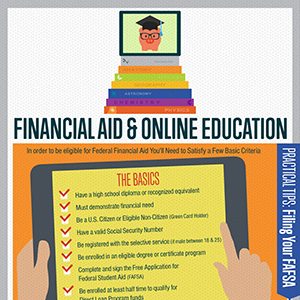
Financial Aid and Online Education
In order to be eligible for Federal Financial Aid you'll need to satisfy a few basic criteria.
The Basics:Have a high school diploma or recognized equivalentMust demonstrate financial needBe a U.S. Citizen or Eligible Non-Citizen (Green Card Holder)Have a valid Social Security NumberBe registered with the selective service (if male between 18 and 25)Be enrolled in an eligible degree or certificate programComplete and sign the Free Application for Federal Student Aid (FAFSA)Be enrolled at least half time to qualify for Direct Loan Program funds
Did you know: Not long ago Congress required schools conduct more than 50% of their teaching in classroom settings to qualify as federal financial aid distributors. This requirement was lifted in 2006, allowing online colleges to disburse federal financial aid.
In order to be eligible for Federal Financial Aid, make sure the schools you're looking at are accredited.Primary accreditation bodies:
Six primary regional agenciesA number of national agenciesAnd scores of programmatic agencies
All of which must be endorsed by the Department of Education
For most purposes accredited online colleges offer financial aid comparable to brick and mortar schools.
The Big Picture:
$185 billion in aid is available for college students every year.
Sources:73% Federal Government18% Institutions of Higher Education5% State Government4% Private Sources
Types of Financial Aid:
Federal:Federal Perkins Loans:Fixed-rateLow-interestBased on greatest financial needAvailable at 1,700 institutions10 year repayment
Federal Direct Loans (Stafford):a.) Direct Subsidized:Fixed-rateLow-interest (3.5%-5%)Not responsible for interest while in schoolb.) Direct Unsubsidized:Low-interest (for undergraduate)Not based on financial needResponsible for paying interest during school
Parent PLUS Loans:Higher interest rates (6%-7.5%)Borrowed by parents (contingent on their credit)Cannot exceed cost of attendance minus other financial aid
State-Based:Multi-state tuition reciprocity agreements:(for undergraduate)a.) Academic Common MarketStudents of member states can cross state lines to major in specific programs not offered in their home states, paying in-state tuition.Ala., Ark., Del.,GA.,KY.,LA.,Md.,Miss.,Okla.,SC, Tenn., VA.,WV.b.) Midwest Student Exchange Program
Discounts to eligible students majoring in specific programs .Ill.,Ind.,Kan.,Mich.,Minn.,Mo.,Neb.,ND.,Wis.c.) New England Student Program
Discounted regional tuition.Conn.,Mass.,Maine,NH.,RI.,Vt.d.) Western Undergraduate Exchange
Can apply for reduced tuition that doesn't take financial need into account.
Ark.,Ariz.,Calif.,Colo.,Hawaii,Idaho, Mont.,NM.,Nev.,ND.,Ore.,SD.,Utah, Wash.,Wyo.
Also: 38 states administer student loans similar to Federal Direct financial aid
Private Student LoansHigher interest rates (fixed and variable)Not Subsidized$150 billion out of $1 trillion in student debt is held in private loans
Aid from Colleges and UniversitiesGrantsScholarshipsWork Study
Many online colleges offer payment reductions:1.) Tuition deferral for employer reimbursement2.) Rebates for cash payments3.) Subscription based payments4.) Only pay to learn the skills you don't know
Grantsa.) Pell Grants
Based on family's financial need, cost of attendance and enrollment status
b.) Federal Supplemental Educational Opportunity Grants
Awarded by participating institutions through college financial aid offices
c.) Teacher Education Assistance for College and Higher Education Grants
Awarded to students pursuing teaching in high need fields in elementary education, secondary education, or for low-income students.
d.) Iraq and Afghanistan Service Grants
For students whose parents were members of the U.S. armed forces and died in Iraq or Afghanistan after 9/11.
Private ScholarshipsTypes:Established in someone's memoryFor underrepresented ethnicitiesContest-based by non-profits or private entities
Trends:Sources of undergraduate financial aid:54% Grants37% Loans9% Tax credits, deductions, and Federal Work-Study
Where to Start: the FAFSA
Required Information:(all that applies)For Parents:SSNW-2 from past yearFederal tax returns past yearRecords of additional untaxed incomeBank statementsInvestment records
For Students:SSNDriver's license numberW-2 from past yearFederal tax returns past yearRecords of additional untaxed incomeBank statementsInvestment records
The Formula:Cost of attendance minus estimated familial commitment equals your financial need
Places to file the FAFSA:
Online: www.fafsa.govBy MailOrder by phone: 1-800-4-FED-AID