North Carolina collaborates with major corporations and industries, and training programs to ensure that companies have skilled professionals they need to fill job vacancies. The state's Career and Technical Education (CTE) enables students to obtain knowledge and skills that potential employers are seeking with a few years of training and education. Students can find professional success even if they don't have a bachelor's degree. With that said, students must consider enrolling in trade schools in North Carolina to get an education that prepares them for in-demand careers in two years or less. Key sectors in the state, namely automotive, energy, and information technology, require skilled professionals who have career diplomas, certificate programs, or technical associate degrees.
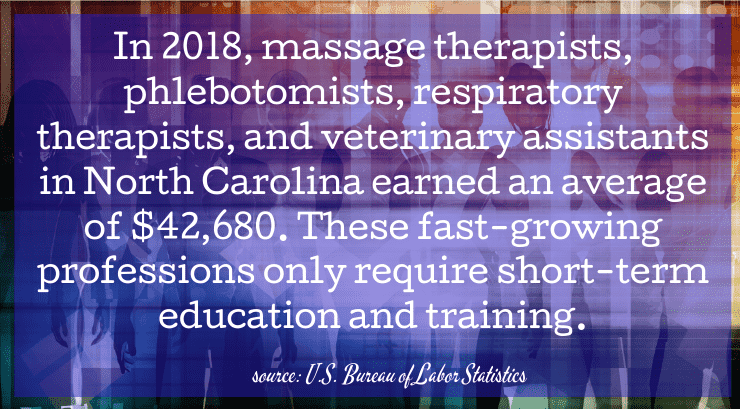
As a concrete example, solar panel installers have arapidly-growing job in North Carolina, according to an analysis reportconducted by Yahoo Finance. According to the Bureau of Labor Statistics, theseprofessionals only require some short-term education and earn median salariesof $42,680 in 2018. Other fast-growing and high-paying occupations in NorthCarolina include massage therapists, phlebotomists, respiratory therapists, andveterinary assistants.
Career prospects differ by region. The North CarolinaDepartment of Commerce reports HVAC technicians and veterinary technologistsare in demand in the Charlotte region. On the other hand, medical assistants,respiratory therapists, and phlebotomists are some of the fastest-growingprofessions in the Raleigh-Durham region.
Why is North Carolina Ideal for Trade Schools?According to the 2018 Employer Needs Survey conductedby the NCWorks Commission, more than 43% of North Carolina's employers expectto grow their hiring in the future. However, half of the employers say theyhave a hard time finding suitable employees, with 49% of them saying it isbecause of the applicant's lack of essential technical skills.

In total, 55% of the state's job market requires some post-secondary education but not a bachelor's degree. According to the National Skills Coalition, only 44% of North Carolina workers are eligible to fill job vacancies. Fortunately, several vocational schools in North Carolina teach Career and Technical Education (CTE) skills and expertise. When it comes to certifications of CTE, North Carolina Community Colleges operate in 58 headquarters, preparing students for professional credentials and state licensure. Online education, on-campus, and apprenticeship programs are offered by these community colleges and other vocational schools in North Carolina.
Financial Aid for Trade Students in North CarolinaThe North Carolina Community College System says publiccareer and technical schools in the state offer some of the country's lowesttuition and fees. Many of these academic institutions offer flexible learningoptions such as online, weekend, and evening classes which mean learners cankeep their job while in college and reduce the need for student loans.
Students can lower their educational expenses even further by applying for financial aid in North Carolina. North Carolina is one of the country's leading states that promoted higher education in 2020 based on the report by the annual Grapevine Survey of Illinois State University. North Carolina also increased its funding for public institutions, universities, and community colleges by 4.8% in 2018 and 18.4% in the last five years. This fund serves as general support for public, academic institutions, as well as support for several North Carolina grants and scholarship programs.
North Carolina's College Foundation has a list ofscholarships available in the state. Students must complete the FreeApplication for Federal Student Aid (FAFSA) to apply for scholarships andgrants in North Carolina. The FAFSA is utilized by the federal and stategovernments as well as vocational and trade schools in the state to determineif someone is eligible for financial aid.
Some of the North Carolina grants and scholarshipprograms available are the following:
Golden LEAF Scholarship Program for North Carolina Community Colleges: This scholarship program awards $750 per semester for eligible students. It is available to residents of rural, economically-distressed areas and has demonstrated financial necessity.
NC Community College Grant Program: These programs are available to North Carolina residents who are enrolled for at least six credit hours each semester in a specific program at a state community college. The quantity of the award depends on the students' financial situation.
North Carolina Education Lottery Scholarship: This program is awarded to those enrolled in a North Carolina Community College or University of North Carolina campus. The amount granted to the student will depend on his or her financial status.
North Carolina's CTE certification is endorsed through state funding and policy initiatives. The provision for career and technical education begins in high school. Not only some schools have their own concrete CTE programs, but also the Career & College Promise which enables high school students to obtain credit for a diploma, certificate, or associate degree program at no extra cost.
Furthermore, the NC Department of Commerce offers numerous Workforce Grants to train professionals for in-demand jobs. Much of this money is directed through employers for on-the-job training and similar programs.
North Carolina Policies that Benefit Trade StudentsNCcareers is a platform initiative of the NC Department of Commerce and is considered one of the most comprehensive career resources available to job seekers in North Carolina. It enables visitors to research professions, review state licensure requirements, and explore a career cluster that matches their interests and qualifications.
Another state resource for career finders is NCWorks Online. The platform has comprehensive information about online learning resources, the option to search for North Carolina scholarships, training and education programs, and resume creation.
North Carolina School-specific Program Initiatives
Charlotte-Mecklenburg Schools provides its students with 19 career pathways that can be explored even in Middle School. Some of these pathways may permit students to receive professional certification even before completing high school. Other public, academic institutions in North Carolina may have similar programs.
Numerous trade schools in North Carolina, as well as the Public Schools of North Carolina, have made it attainable for students to join in Work-Based Learning (WBL). This enables students to obtain credit while gaining real-world experience in the workforce.

While you already know what makes attending a trade school in North Carolina ideal, there could be setbacks when you choose to enroll in one that does not meet the right standards or proves to be inconvenient for you. You will need in-depth research to make the best pick, and pursue a diploma or certificate that suits your needs.
OnlineSchoolsCenter.com helps make the journey ofchoosing the right trade school—online and on-campus—easier for you. Our staffand researchers rounded up the best trade schools in North Carolina that areknown for these features:
Impressive courses and curricula that emphasize the most in-demand skills in the state's industries,
High retention rates,
A positive experiential learning experience for students,
Impressive faculty credentials that highlight training and industry expertise,
Access to financial aid options,
Accredited by governing academic bodies and workforce development agencies.
Please read our Methodology page for our ranking details.
Here's your most comprehensive guide for findingthe best trade schools that deliver training and education across allindustries. Navigate our quicklinks below:
- The Best Overall Campus Trade Schools in North Carolina
- The Best Overall Online Trade Schools in North Carolina
- The Best Diesel Mechanics Trade Schools in North Carolina
- The Best Pharmacy Technology Trade Schools in North Carolina
- The Best Criminal Justice Trade Schools in North Carolina
- The Best Horticulture Trade Schools in North Carolina
- The Best Culinary Trade Schools in North Carolina
- The Best HVACR Tech Trade Schools in North Carolina
- The Best Auto Repair Trade Schools in North Carolina
- The Best Dental Hygiene Trade Schools in North Carolina
- The Best Medical Billing and Coding Trade Schools in North Carolina
- The Best Cosmetology Trade Schools in North Carolina
- The Best Information Technology Trade Schools in North Carolina
- The Best Photography Trade School in North Carolina
The Best Overall Campus Trade Schools in North
Carolina
North Carolina works in collaboration with several industries and training programs to make sure that companies have the skilled professionals they need to fill crucial jobs. North Carolina's career and technical education enables students to gain the essential skills and expertise within a few years of study.
The state has committedto delivering quality vocational education to residents. During 2013-2015,Governor Pat McCrory made budget recommendations that would offer an additional$32 million to community colleges supporting programs in technology trainingand engineering. He also recommended that $28 million be allocated forequipment and infrastructure for North Carolina's community college system overthe following years.
Healthcare industriesare a growing sector in North Carolina. Popular professions among vocationalstudents include dental hygienists, medical assistants, nursing assistants, andregistered nurse jobs. With 100 community healthcare facilities/hospitals, fouracclaimed medical schools, six research hospitals, and private organizationssuch as LabCorp, Pfizer, and Novo Nordisk, the state's vocational students canutilize their training and education in a variety of healthcare settings.

Asheville-Buncombe Technical Community College has six campus headquarters located in North of Fletcher to Marshall. Two-year degree programs are taught in allied healthcare, applied technology, and emergency services. Classroom, hands-on or laboratory instructions and theory are all part of the school's trade training and education programs. Graduates can work in construction, civil engineering, criminal justice, culinary, and medical billing and coding. Registration for degree programs must be completed before deadlines. Students can enjoy several student support services such as academic advising, computer laboratories, writing center, tutoring services, academic learning facilities, and other learning resources. Distance learners can access InfoBase, Moodle, Student Email, and WebAdvisor.
Fayetteville Technical Community College prepares learners to work in different areas of study such as culinary arts, healthcare management, business, hospitality, global logistics and distribution, HVAC, and automotive. Classes are held in two different locations, namely Fort Bragg Center and Spring Lake Campus. High School Connections is a member of the state's Career and College Promise program. Through this initiative, high school students enroll in college courses together with their required secondary curriculum. The Student Learning Center, Children's Center for learners who are parents, university outreach, and student advising are some of the student support services that they can utilize. Graduates can explore relevant careers using the school's online job board.
Guilford Technical Community College offers early and traditional registration. Established in 1958, the school accepts applications via its open admissions policy at each of its four headquarters. Culinary arts, horticulture, construction management technology, entertainment technology, nursing, and electronics engineering are some of the programs offered by this community college. The school has a co-enrollment engineering program collaboration with North Carolina AT&T State University. Through this agreement, all academic credits in Guilford Technical Community College's engineering program transfer into North Carolina AT&T State University's four-year bachelor's degree program.
McDowell Technical Community College is headquartered in Marion, North Carolina, that offers Associate of Applied Science degree programs in nursing, electrical systems, industrial systems, and general occupational, vocational specializations. Its small business facilities offer magazines and pamphlets, counseling, and trade journals to area entrepreneurs, including graduates of its trade degree programs who plan to pursue business ventures. Applications are accepted in person through the school's Student Services Offices. Placement examinations are also conducted on campus. Prospective students are recommended with an adviser to plan their class schedules.
Pitt Community College provides associate of applied science degree programs in different vocational fields such as industrial management technology, nursing, HVAC, mechanical engineering, office administration, industrial systems technology, and welding. Also, the school provides select continuing education classes to assist students in preparing for licensing and certification requirements. A work-based learning format is one option in which learners can utilize their professional experience to obtain academic credits. For 160 hours of professional experience, eligible students can receive one-semester credit. All freshmen students are required to attend new student's orientation regardless of the program that they are enrolled.
The Best Overall Online Trade Schools in
North Carolina
North Carolina trade and vocational schools provide several online educational opportunities to in-state online students. Through online programs, learners can study from many of North Carolina's most prestigious academic institutions, completing lectures and assignments through distance learning and at their convenience. eLearningNC suggests that distance learning is an optimal learning format, as distance learners retain information much better than their on-campus counterparts.
Academic institutions in the state have gained benefits from different state support initiatives and programs. North Carolina has an online learning commission that emphasizes making sure that its 58 community colleges, 36 private institutions, and the University of North Carolina systems of schools all advocate student success through online learning. The state's distance learners also benefit from North Carolina's membership in the Southern Regional Educational Board. The membership offers students who are enrolled in select out-of-state programs with in-state tuition rates; it applies to all students studying a program not offered within their state. Active duty military men and women, as well as their families, also qualify for in-state tuition in North Carolina.
Cape Fear Community College is one of the bigger vocational schools in Wilmington, North Carolina, with a student population of more than 23,000. It has over 60 trade degree programs that attract both traditional and distance learners. As a commitment to its excellent academics, graduates from some of the degree programs have 100% passing rates on certification examinations. The trade programs fall into six major categories, namely vocational, allied health services, public service, business technologies, marine technology, and engineering technology. Among its most popular programs are basic law enforcement training and truck driver training. Some of the school's programs have work-based learning formats.
Edgecombe Community College is considered one of the best trade schools in Tarboro, North Carolina, through its affordable tuition rates, highly-qualified professors, and distance learning programs. Adult students will be in good company since the average age of students is 30 years old. Despite its main campus located in Tarboro, learners can also study at the college's Rocky Mount location where high-tech facilities enable healthcare students to train and learn in a simulated hospital setting. There are over 200 education programs at the school. These programs include work-based learning that offers credit for employment and online programs that result in certificates, diplomas, or degrees. Early childhood education, business administration, and engineering are some of the few offerings for online students.
Forsyth Technical Community College
Forsyth Technical Community College is another option as one of the top career schools in Winston-Salem, North Carolina. It has progressed since its establishment in 1960 to deliver not only trade programs but academic degree programs as well as continuing education courses. Known as Forsyth Tech, the college enrolls more than 11,000 learners per year at ten campus and learning facilities. When it comes to CTE certification training in North Carolina, Forsyth Tech has several options. Its CareersNOW classes prepare learners for new careers in six months or less. These classes cover a variety of occupations, such as phlebotomy, basic construction, carpentry, and education. Career diploma, certificate, and degree programs are available in several other areas of interest. For distance learners, there are programs in medical terminology, medical coding, and substitute teacher training.
Johnston CommunityCollege aims to meet the needs of a variety of students, enrolling more than 13,000 learners each year. It provides transfer program options as well as trade education. Dual enrollment opportunities mean high school students can obtain college credit before their graduation. Considered as one of the best career and technical academic institutions in Smithfield, North Carolina, the school has no shortage of trade learning options. Through the school's Career in a Year Initiative, learners can select from more than 70 certificate and diploma programs that will allow them to join the workforce immediately or meet North Carolina's CTE certification eligibility requirements. There are more extended degree programs in the fields of Nursing and Applied Engineering. Furthermore, the college hosts the Johnston County Apprenticeship Program for students seeking hands-on learning.
Lenoir Community College's learners can study at one of nine campus headquarters or choose to enroll in online classes. Through the school's academic and support programs, it provides innovative educational programs. As a concrete example, the Lenoir Community College Manufacturing Academy is committed to preparing professionals to fill-in career prospects at local industry partners, while the Minority Male Success Initiative pursues to develop retention and graduation rates among qualified students. Students can obtain degrees, diplomas, and certificates, either on-campus or distance learning at LCC. Program offerings range from aviation management and career pilot technology to welding technology. Furthermore, accelerated 5-week classes are available during summer, and more than 50 programs can be completed 100% online.
Pamlico Community College is considered a military-friendly community college that is known for its high graduation rate and low student-faculty ratio. It was acknowledged by The Aspen Institute, a not-for-profit, and non-partisan think tank, as being one of the top 150 schools for the 2020 Aspen Prize for Community College Excellence. Established in 1962, the community college offers a great learning environment, enrolling lesser than 500 students per year. The school breaks down its programs into three major categories: cultural and life enrichment, academic programs, and continuing education. Within the academic offerings are transfer programs as well as vocational education for fields such as cosmetology, and electrical systems technology. The school grants certificates and degree programs, depending on the programs of interest.
Stanly Community College has been meeting the academic-related needs of students from different walks of life, providing them transfer degrees, adult education, and vocational training. SCC participates in the American Association of Community Colleges Pathways Project, which is proposed to make sure its curriculum is aimed to maximize students' success. The vocational programs in this community college range from health sciences to advanced manufacturing. Students who are interested in pursuing an HVAC degree can enroll at SCC. Moreover, the school is reputable for its innovative and comprehensive competency-based learning program in Information Technology. The program enables learners to obtain credit for previous experience as they progress through the curriculum at their convenience and timeframe of learning.

Wayne Community College offers certificates, diplomas, career skills training, and associate degree programs in affordable and high-quality learning. With more than 50 years of academic excellence, Wayne Community College has long been holding the reputation of meeting the needs of learners from different backgrounds. Currently, the school offers online classes, short-term training, dual education, and evening programs. With more than 100 offerings to choose from, students are ensured to find programs that are suitable for their preferences and needs. Several certificates, diplomas, and associate degree programs can be completed entirely online, including the school's popular options in dental hygiene, medical billing, and business. The school also provides training in growing healthcare professions such as medical assisting and practical nursing.
Are you looking for an interesting trade that you can pursue as a career? Check this out: 30 High Paying Trade School Degrees and Jobs 2020
The Best Diesel Mechanics Trade Schools in North Carolina – Campus and Online

Thanks to the growing transport sector in the U.S., there is an increasing demand for skilled diesel mechanics. Students who want to change their lives and improve their earning potential may choose a diesel mechanic program in North Carolina. There are several schools with diesel mechanic programs in North Carolina, including community colleges and vocational schools. The average cost of tuition in the state is $2,214, which is relatively less compared to other schools in different states.

There are no licensing requirements in the state of North Carolina for diesel mechanics, making it an attractive state for students who want to begin their careers immediately after completing their degrees. ASE Certification is a nationally-recognized and optional standard for automobile specialists. Students who have met the education and employment requirements of the ASE Certification can sign up for the examinations they want to take. If students pass the exam, they obtain ASE Certification for five years.
The career outlook for diesel mechanics across the U.S. is promising. The Bureau of Labor Statistics projects 5% career growth for diesel mechanics between 2018-2028. Job openings for diesel mechanics are projected to grow by 6% in North Carolina through 2020, according to O*Net. The wage as a diesel mechanic depends on several factors, including employer, work experience, and seniority. Typically, they can earn between $27,700-$56,600 per year. The median wage for diesel mechanics in North Carolina is $39,800 per year.
Guilford Technical Community College offers Diesel Programs for several years and has trained students for businesses in North Carolina and beyond. The school's modern state-of-the-art facilities and educational program will ensure that they receive training and education to an excellent degree. The program teaches foundational knowledge and expertise that students need to qualify for career opportunities in heavy-duty vehicles and diesel-powered equipment. Learners will gain insight into the principles, construction features, and purpose of the operation of medium and heavy-duty vehicles. Sample courses include Preventative Maintenance, Transp Climate Control, Basic Transp Electricity, Suspension and Steering, and Mechanical Transmissions. The number of required credit hours for the diploma program is 42 credits, while the certificate program is 15 credits.
Official Program Name: Diesel and Heavy Equipment Technology
Program Level: Certificate, Diploma
Learning Format: On-Campus
Financial Aid: Scholarships, State, Federal, and School-based Awards, Student Loans, Grants, Federal-Work Study Programs
Forsyth TechnicalCommunity College has a Diesel and Heavy Equipment Technology program thatprovides students with training in air brakes, electronic engine controls,drive train and air conditioning/heating systems, diesel engine repair,mechanical transmissions; preventative maintenance; suspension and steeringsystems; and electrical systems. Students in the associate program must have 72credits for the graduation of the program. The core courses consist of BasicWelding Processes, Preventative Maintenance, Basic Transp Electricity,Mechanical Transmissions, Suspension, and Steering.
Official Program Name: Diesel and Heavy Equipment Technology
Program Level: Certificate, Diploma, Associate
Learning Format: On-Campus
Financial Aid: Grants, Scholarships, Student Loans, Federal-Work Study Programs
Davidson County,Community College's Diesel and Heavy Equipment Technology program, preparesstudents for employment as entry-level transportation service specialists. Itoffers an introduction to diesel and heavy equipment industry professionalpathways and expands students' awareness of diverse technologies related tothis challenging industry. Students are required to take core diesel courses,including Introduction to Transport Technology, Diesel Fuel and Power System,Electronic Engines, Advanced Hydraulics, and Medium/Heavy Duty Brake Systems.
Official Program Name:Diesel & Heavy Equipment Technology
Program Level: Associate, Certificate, Diploma
Learning Format: On-Campus
Financial Aid: Federal and State Grants; Scholarships; Student Loans; Federal-Work Study

Wake Tech offers a diesel and heavy equipment technology program that prepares students for the technical knowledge and capabilities needed to repair, diagnose, maintain and service diesel engines in vehicles such as ships, buses, heavy-duty trucks, equipment, railroad locomotives as well as stationary diesel engines in electrical equipment, generators, and other related components. Required coursework includes Introduction to Transport Technology; Basic Transportation Electrical Lab; Transportation Climate Control Lab; Basic Welding for Transportation; and Electronic Engines. Graduates of the program may be eligible to take professional licensure examinations, which correlate to specific areas of study and to join in the workforce as entry-level technicians in the transportation sector.
Official Program Name: Diesel and Heavy Equipment Technology
Program Level: Certificate, Diploma, Associate
Learning Format: On-Campus
Financial Aid: Grants; Work-Study Programs; Loans; Scholarships
Central Piedmont Community College has an Associate in Applied Science-Diesel and Heavy Equipment Technology that has partnered with Carolina CAT/LiftOne to develop the Carolina CAT Service Technician Program to meet the standards for high-tech and hands-on professions. The program has been certified by the National Automotive Technicians Education Foundation and highlights state-of-the-art transmission, electrical laboratories, hydraulic, and engines that maintain the current diagnostic components. Students can either enroll in the associate, certificate, or diploma program, with a different number of credits for graduation. Sample courses include Diesel Engines, Basic Welding for Transportation, Suspension and Steering, Transportation Climate Control, and Introduction to Transport Technology.
Official Program Name: Diesel and Heavy Equipment Technology
Program Level: Associate, Diploma, Certificate
Learning Format: On-Campus
Financial Aid: Student Loans; Grants; Scholarships; Veterans Affairs Education Benefits
For online learning options, see our Best Online Schools for Diesel Mechanics Programs
The Best Pharmacy Technology Trade Schools in North Carolina – Campus and Online

Studentswho have an interest in the growing field of healthcare can consider a pharmacytechnician profession. As a pharmacy tech, they work under the supervision of alicensed pharmacist, preparing medicines. Their duties include keeping accuraterecords of dosages of prescribed medications, mixing and measuring liquids,labeling prescriptions, and counting pills. In North Carolina, there areseveral opportunities in healthcare and pharmacy technician sectors.
Students must have a high school diploma or equivalent or be registered in a high school diploma program to become a pharmacy technician in North Carolina. Registration to the North Carolina Board of Pharmacy requires candidates to be employed by a pharmacy holding a valid in-state permit and to earn a training program offered by the pharmacist.
The training fundamentals conducted by a pharmacist will include record-keeping and documentation, calculations, pharmacy laws and regulations, handling and storage of medicines, and dispensing systems and requirements for labeling. Students can also obtain registration in North Carolina if they have a certification through the Pharmacy Technician Certification Board (PTCB).
According to the Bureau of Labor Statistics, the pharmacy technician industry is expected to grow 7% from 2018-2028, faster than the average for all occupations. There are numerous reasons for the higher demand for prescription medications, including the aging population and higher rates of chronic diseases among all age populations.
In 2018, the median annual wage for pharmacy technicians was $32,700. This indicates that half of all those who had worked for this position earned more, and the other half earned less. The annual mean wage for North Carolina pharmacy tech is $30,890, and the hourly rate is $14.85.
Fayetteville Technical Community College runs an Associate in Applied Science-Pharmacy Technology program that has garnered accreditation from the Pharmacy Technician Accreditation Commission. It prepares students to assist pharmacists in duties as well as perform legally within the boundaries mandated by the employment agencies and pharmacists. Students must have 67 credits for completion of the program. Sample courses include Basic Anatomy and Physiology; Career Assessment; Trends in Pharmacy; Community Pharmacy; and Introduction to Computers.
Official Program Name: Pharmacy Technology
Program Level: Associate
Learning Format: On-Campus
Financial Aid: Veteran's Educational Benefits; Grants; Student Loans; Scholarships; Workforce Investment Act; Work-Study Programs
Guilford Technical Community College's Pharmacy Technology Program provides interactive, hands-on learning in laboratory facilities and experiential rotations through local pharmacies. The program receives accreditation from the American Society of Health-Systems Pharmacists. It prepares students to sit for examinations to become nationally-certified through the Pharmacy Technician Certification Board. Individuals are ready to assist pharmacists in roles and responsibilities that a pharmacy technician can legally work and to perform within the boundaries authorized by the pharmacist and the employment agency. Students complete courses in Pharmacy Professional Practice; Pharmacy Calculations; Pharmacology; Pharmacy Dosage Forms; and Hospital Pharmacy. An associate degree requires 65 credits, while the diploma program requires 37 credits for graduation.
Official Program Name:Pharmacy Technology
Program Level: Diploma, Associate
Learning Format: On-Campus, Hybrid
Financial Aid: Scholarships; State, Federal, and School-based Awards; Student Loans; Grants; Federal-Work Study Programs
StanlyCommunity College has a pharmacy technology program where students can chooseeither a certificate, diploma, or associate level of completion. The associateprogram requires 75 credits, the diploma requires 40 credits, and the careerand college promise program requires 17 credits. They complete required courses,including Introduction to Pharmacy; Pharmacology I; Pharmacy Calculations;Pharmacy Practice I; and College Student Success. The program is offered in anAGE Pathway where students start their academic journey by completing all thegeneral education requirements.
Official Program Name:Pharmacy Technology
Program Level: Certificate, Diploma, Associate
Learning Format: On-Campus
Financial Aid: Veteran Benefits; Student Loans; Work-Study Programs; Federal Grants; Scholarships; Emergency Fund Program; Emergency Loan Program
ForsythTechnical Community College's Pharmacy Technology program prepares graduates toassist the pharmacist in duties that personnel can legally perform and to workwithin the boundaries prescribed by the employment agency and pharmacist. Graduatesmay be qualified to take the National Certification Examination to become acertified pharmacy tech. This 71-credit pharmacy technology program hasrequired courses in Pharmacy Calculations; Introduction to Pharmacy; Trends inPharmacy; Community Pharmacy; and Pharmacy Dosage Forms.
Official Program Name: Pharmacy Technology
Program Level: Diploma, Associate
Learning Format: On-Campus
Financial Aid: Grants; Scholarships; Student Loans; Federal-Work Study Programs
Johnston Community College offers an Associate of Applied Science-Pharmacy Technology program that earned accreditation from the American Society of Health-System Pharmacists/Accreditation Council for Pharmacy Education. Learners will prepare prescription medications, update patient records, mix solutions, and other specialized medications, gather data utilized by pharmacists to monitor drug therapy and maintain inventories and medications. Students must have 67 credits for completion. Sample courses include Sterile Products; Trends in Pharmacy; Hospital Pharmacy; Introduction to Ethics; and Pharm Dosage Forms.
Official Program Name: Pharmacy Technology
Program Level: Associate
Learning Format: On-Campus
Financial Aid: Federal and State Grants; Scholarships; Emergency Loans for Books; Veteran Benefits; Alternative/Private Loans
For an online option, see: OSC's Choices For Online Trade Pharmacy Technology Certificate Programs
The Best Criminal Justice Trade Schools in North Carolina – Campus and Online

Studentspursuing a career in criminal justice must consider that several lawenforcement agencies require a two-year or a four-year degree. Although someagencies accept degrees from programs in different areas of interest,candidates who hold a criminal justice-related degree may receive preferentialstatus in the hiring process or offered a higher starting wage. Financial aidopportunities specific to North Carolina residents include Golden LEAF ScholarsProgram, the State Employees Association of North Carolina Scholarship, and theNorth Carolina Student Incentive Grant. Students' eligibility depends on theirfinancial needs; however, there are merit-based scholarship programs as well.
Recent graduates who are seeking their first criminal justice position should carefully research the job description of each prospective role. Several jobs that involve laboratory forensics will also require science-based training and education. The most popular entry-level criminal justice positions are court staff, corrections officers, and local police officers. Career finders must consider career opportunities at the federal and state levels to increase their chances of finding appropriate employment.
Legal assistant and protective services careers are among the most popular paths for criminal justice majors. The demand for both of these fields is projected to rise on a national level. The U.S. Bureau of Labor Statistics reveals that protective services careers in the state pay a mean annual wage of $38,610.
Whetherit is a young student who is just starting his or her post-secondary educationor an experienced professional who is looking for a career shift or careeradvancement, obtaining a criminal justice degree can have numerous benefits. Inaddition to providing job stability and lucrative salaries at the managementlevels and in the private sectors, the criminal justice industry is expected tocontinue its trend of promising growth as more and more government facilitiesand private sectors seek to increase security and law enforcement personnel.
Asheville-BuncombeTechnical Community College has an Associate in Applied Science-CriminalJustice Technology that is designed to provide expertise and knowledge ofcriminal justice systems and methodologies. Sample courses include QuantitativeLiteracy; Constitutional Law; Professional Research and Reporting; Introductionto Criminal Justice; Writing and Inquiry; and Success and Study Skills. A totalnumber of 65 credits is required for the completion of the program. All coursesrequire a grade of "C" or better.
Official Program Name: Criminal Justice Technology
Program Level: Associate
Learning Format: On-Campus
Financial Aid: Scholarships; Federal and State Grants; Direct Loans; Work-Study Programs
PittCommunity College's criminal justice technology program will provide graduateswith the essential skills and training they need to be marketable in the jobmarket. They will demonstrate how crime and criminal justice procedures andconcepts interact and intersect to offer well-planned justice administration.Sample courses include Investigative Photography, Juvenile Justice, LawEnforcement Operations, Ethics, and Community Relations, and Introduction toCriminal Justice.
Official Program Name:Criminal Justice Technology
Program Level: Associate
Learning Format: On-Campus
Financial Aid: Grants; Scholarships; Federal Work-Study Employment; Federal Loans
GuilfordTechnical Community College offers Criminal Justice Technology programs thatcan be completed on-campus or entirely online. The program is designed todeliver practical knowledge of criminal justice processes and procedures. Thetraining emphasizes on federal, local and state law enforcement, corrections& security services, and judicial procedures. The certificate programs areoffered in four specializations, namely Homeland Security, Intervention,Criminal Justice Foundations, and Law Enforcement Management. Sample coursesinclude Criminal Law, Ethics and Community Relations, Court Procedures andEvidence, Law Enforcement Operations, and Juvenile Justice. An associate degreeprogram of criminal justice requires 66 to 68 credits for completion.
Official Program Name:Criminal Justice Technology
Program Level: Certificate, Associate
Learning Format: On-Campus, Online
Financial Aid: Scholarships; State, Federal, and School-based Awards; Student Loans; Grants; Federal-Work Study Programs

StanlyCommunity College's criminal justice technology program is designed to helpstudents in the application of ethical decision-making procedures to criminaljustice challenges, describing modern techniques and methodologies of criminalinvestigations, composing written communication for criminal justice concepts,and identifying contemporary theories in criminal justice. This 66-creditcriminal justice program has core required courses such as Juvenile Justice,Crisis Intervention, Court Procedure & Evidence, Constitutional Law, andEthics and Community Relations.
Official Program Name: Criminal Justice Technology
Program Level: Diploma, Certificate, Associate
Learning Format: On-Campus, Online
Financial Aid: Veteran Benefits; Student Loans; Work-Study Programs; Federal Grants; Scholarships; Emergency Fund Program; Emergency Loan Program
ForsythTechnical Community College has a Criminal Justice Technology program that isdesigned to deliver knowledge of criminal justice procedures and processes. Theprogram emphasizes on federal, local and state law enforcement, securityservices, corrections, and judicial processes. Students are required to have 64credits for the graduation of the program. They complete core criminal justicecourses such as Investigative Principles, Juvenile Justice, Criminal Law,Introduction to Criminal Justice, and Prof Research and Reporting.
Official Program Name:Criminal Justice Technology
Program Level: Certificate, Associate
Learning Format: On-Campus
Financial Aid: Grants; Scholarships; Student Loans; Federal-Work Study Programs
See our picks for the Top 20 Online Schools for Bachelor of Criminal Justice Degree Programs and check this out: Forensic Sketch Artist via Criminal Justice Degree Programs
The Best Horticulture Trade Schools in North Carolina – Campus and Online

Ahorticulturist is a person who utilizes scientific knowledge to propagate andcultivate plants and then make use of this scientific knowledge to delivertechnical information to fruit, flower, vegetable growers as well as farmers.He or she will perform experiments and pest & disease investigations withenhanced varieties of plants with higher resistance to diseases. They will alsowork in the field of landscaping design to develop gardens, parks, andrecreational areas to preserve natural resources. Some of them work in themining sector, assisting in regenerating degraded land.
Horticultureis a division of agriculture which primarily deals with the reproduction ofplant life. It involves the cultivation and management of lands and gardens. Ahorticulturist in North Carolina can establish in several roles, but as ageneral rule of thumb, these are professional experts in the growth anddevelopment of food and other types of plants. They can work in education,government, industry, or private sectors.
Themajority of horticulturists work outside, in laboratories or greenhouses,depending on the nature of their specialized work. Typically, working in thehorticulture industry involves several hands-on tasks. Whether harvesting,pruning, or planting, there is a lot of physical activity required. While theytend to work on regular hours, their workload gets busier during the plantingand harvesting periods.
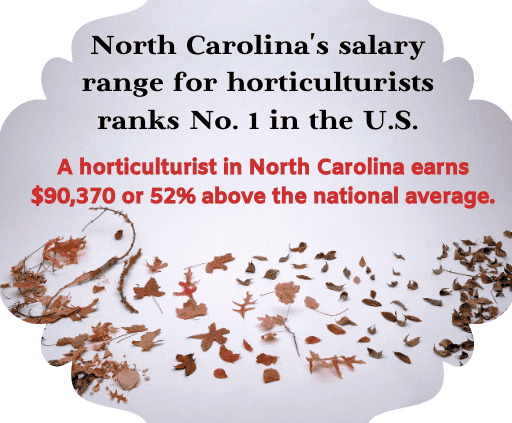
Theaverage wage for a horticulturist in the U.S. is around $49,108 annually. Salariesgenerally start from $37,240 and increase up to $107,499. In North Carolina, ahorticulturist earns an average of $90,370, which is 52% above the nationalaverage. The state ranks #1 in the salary range of horticulturists in theUnited States. There are an estimated 1,028,700 horticulturists in the country.The horticulturist labor market is projected to decrease by -0.8% between 2016and 2026. Over the next decade, the country is expected to lose 6,500horticulturists as the retirement of 1,500 existing horticulturists looms.
PittCommunity College's horticulture technology program provides students the essentialtools required to be successful in the Green Industry, one of NC's biggestindustries. Students obtain hands-on experience through different livelandscape projects and working in Pitt's state-of-the-art on-campus greenhousecomplex. Sample courses include Horticulture Pest Management, HorticultureManagement, and Marketing, Landscape Construction, Introduction to TurfgrassCult & ID, and Plant Propagation.
Official Program Name:Horticulture Technology
Program Level: Associate
Learning Format: On-Campus
Financial Aid: Grants; Scholarships; Federal Work-Study Employment; Federal Loans
Guilford Technical Community College has Turfgrass Management programs that provide learners with the necessary skills, instructions, and expertise for a fulfilling career in the turfgrass sector. The program has a curriculum that is aimed at getting students into the workforce quickly and efficiently. Students also receive training from state-of-the-art facilities using industry-standard guidelines and protocols. It is developed to deliver essential skills to perform roles and responsibilities related to the management of sports field, golf courses, sod production, lawn care, and irrigation design. Students can either enroll in the associate degree program or certificate programs. Students complete core required coursework in Turfgrass Equipment Management; Turfgrass Calculations; Landscape Construction; Spring Gardening Lab; and Turfgrass Pest Control.
Official Program Name: Turfgrass Management
Program Level: Certificate, Diploma, Associate
Learning Format: On-Campus
Financial Aid: Scholarships; State, Federal, and School-based Awards; Student Loans; Grants; Federal-Work Study Programs
ForsythTechnical Community College's Horticulture Technology program emphasizes thegeneral production and management of plants, groundcovers, flowers, shrubs, andplant-related components; basic scientific principles required to understandplants and their care and management; and management of the business andtechnical operations connected with horticultural services. A total of 72credits is needed for the graduation of the program. Sample courses includeLandscape Construction, Plant Propagation, Greenhouse Operations, BasicLandscape Technique, and Hort Pest Management.
Official Program Name:Horticulture Technology
Program Level: Certificate, Associate
Learning Format: On-Campus
Financial Aid: Grants; Scholarships; Student Loans; Federal-Work Study Programs
Recommended Schools

WayneCommunity College offers a turfgrass management technology program thatprepares students for different careers in horticulture. Classroom training andpractical laboratory experiments of horticulture concepts and principles areintegrated into the program of study. It emphasizes on turfgrasses and relatedplants and prepares learners to enhance recreational or ornamental grasses andother associated products. Students must have 65 credits for completion of theprogram. The program's core courses include Landscape Maintenance, TurfgrassIrrigation and Design, Introduction to Horticulture, Agricultural Accounting,and Turfgrass Management Apps.
Official Program Name:Turfgrass Management Technology
Program Level: Associate
Learning Format: On-Campus
Financial Aid: N/A
Additional online options to consider: Best Online Trade Schools for Horticulture Programs
The Best Culinary Trade Schools in North Carolina – Campus and Online

Locatedon the East Coast, North Carolina is a culinary paradise that brings togetherEast Coast and Southern cuisine styles of culinary. There are more than 9.8million residents in North Carolina, but the state also has an active tourismsector that brings thousands of visitors to the state every year. The majorityof tourists visit major cities in North Carolina, including Charlotte,Greensboro, and Raleigh. Despite all of the attractions in the state, the costof living is slightly lesser than the national average.
The state's reliance on educated, skilled chefs is evident when students consider the 22 culinary schools in North Carolina. These academic institutions provide a variety of certificate and associate degree programs. The average tuition cost in North Carolina is $5,322, which is partially balanced by the average scholarship grant of $1,593. With an average acceptance rate of 51%, students must put their best foot forward while applying.
Whether they choose a certificate or associate degree, students may learn much of the same education and training. Instead of starting with lots of book knowledge, students can jump-start their culinary training and education by obtaining lots of hands-on training. While it is also important to have book knowledge, students need practical cooking skills to work in the kitchen setting. They move from basic preparation work to advanced cooking techniques as they move forward through the program.
North Carolina is home to several prestigious culinary employers such as Ovations Food Services, Norwegian Cruise Line, and Landry's Restaurants. Most chefs work for restaurants; however, graduates may find careers as a private chef or caterer. The state offers a fair amount of freedom to chefs and cooks since North Carolina does not require any certification or licensure to work. However, there are certification programs that are optional to help graduates get a job. The American Culinary Federation is one of the best certification programs known in the country.
As achef/cook, salaries can be determined by several factors. The most crucialfactor is generally working experience. The more experience a person has, themore money they can make starting and the more potential they have to increasetheir earning power.
Asheville-Buncombe Technical Community College
Asheville-Buncombe Technical Community College's culinary arts programs have garnered accreditation from the American Culinary Federation. The program provides rigorous training necessary for students to assume positions as professional culinary personnel in several food and beverage settings such as healthcare facilities, catering operations, full-service restaurants, contract foodservice, and beach resorts. This 76-credit culinary arts program has core courses such as Beverage Management, Sanitation and Safety, Garde Manager, Cost Control-Food and Beverage, and Food Science.
Official Program Name:Culinary Arts
Program Level: Associate
Learning Format: On-Campus
Financial Aid: Scholarships; Federal and State Grants; Direct Loans; Work-Study Programs
GuilfordTechnical Community College offers a Culinary Arts program, considered as oneof the only two North Carolina culinary institutions that have receivedaccreditation from the American Culinary Federation's Educational Institute atthe Exemplary level. The culinary arts program offers specific training neededto prepare students to earn positions as trained culinary professionals inseveral food service settings such as catering operations, hotels, full-servicerestaurants, resorts, healthcare facilities, and contract food service. Samplerequired culinary courses include Food and Beverage Service; Garde-Manger;Nutrition for Foodservice; Cost Control-Food & Beverage; and Sanitation andSafety.
Official Program Name: Culinary Arts
Program Level: Certificate, Diploma, Associate
Learning Format: On-Campus
Financial Aid: Scholarships; State, Federal, and School-based Awards; Student Loans; Grants; Federal-Work Study Programs
CentralPiedmont Community College has a Culinary Arts program that can either be takenas an associate degree or a certificate specialization. Students can choosefrom six certificate offerings, namely Culinary Skills, Culinary Arts,Certified Fundamentals Cook, Sustainable Food Systems and AgriTourism; ColdFoods; and Baking. Certificate programs require 13-16 credits for completion,while the associate equivalent requires 74 credits for graduation. Studentswill complete required culinary courses such as Menu Design, Nutrition forFoodservice, Culinary Skills, Food and Beverage Service, Sanitation and Safety,and Success in Hospitality Studies.
Official Program Name: Culinary Arts
Program Level: Certificate, Associate
Learning Format: On-Campus
Financial Aid: Student Loans; Grants; Scholarships; Veterans Affairs Education Benefits
Do you need an online program? If so, see our picks for America's Top Online Culinary Schools
The Best HVACR Tech Trade Schools in North Carolina – Campus and Online

Beingemployed as a Heating, Ventilation, Air Conditioning, and Refrigeration (HVAC-Ror HVAC) professional in North Carolina can mean stable employment andopportunities for career advancement. The demand for these skilledprofessionals is projected to grow around the nation as well as North Carolina.
Not onlythat, the wage prospects are promising for HVAC Technicians in North Carolina,but there are also several professional associations and resources for theseclimate-control technicians. The Bureau of Labor Statistics says HVAC Workersand Technicians around the country made an annual average wage of $50,160. Thefigure is almost the same as the mean annual salary of all occupations at$51,960 and is relatively generous payment in a career that does not require afour-year bachelor's degree program.
In the state, there is also a wealth of HVAC and trade associations to deliver mentoring, legal advocacy, job posting boards, and continuing education opportunities in this profession. As a concrete example, the Plumbing-Heating-Cooling Contractors Association of North Carolina is primarily committed to the advancement of the methodologies and technologies in HVAC and the advocacy of rigorous safety standards for all professionals. This department of the PHCCA conducts training and organizes events as well as it serves as a voice for members of this industry. The Refrigeration Service Engineers Society has succeeding North Carolina associations and chapters.
HVAC Technicians in North Carolina may specialize in commercial heating, radiant heating, solar panels, and other HVAC-related specializations, or they have core general knowledge of several HVAC systems and requirements. Prospective candidates for the HVAC field must be aware that there is one mandatory certification for all HVAC workers/technicians in the United States who work with the reuse and recovery of refrigerants – the EPA Section 608 Credential. This certification guarantees that an HVAC technician uses the proper methods in moving, recycling, or replacing materials that are hazardous to the environment.
PittCommunity College's HVAC-R program can either be completed as an associate,certificate or diploma program. Learners who are enrolled full-time and makingsatisfactory learning progress can earn their degree in five semesters. Theycomplete major courses such as Residential System Designs, Heat Pump Technology,Schematics and Diagrams, HVACR Customer Relations, and Commercial HVACControls.
Official Program Name:Air Conditioning, Heating, and Refrigeration
Program Level: Certificate, Diploma, Associate
Learning Format: On-Campus
Financial Aid: Grants; Scholarships; Federal Work-Study Employment; Federal Loans
FayettevilleTechnical Community College offers an HVAC-R program that delivers basicknowledge to enhance capabilities essential for employment in the HVAC-Rindustries. Students can either complete the program as an associate,certificate, or diploma program, varying program lengths, and creditrequirements. Sample courses include Heating Technology, Hydronic Heating,Comfort Cooling, HVAC Systems Diagnostics, and HVAC Duct Systems. Graduates ofthe diploma level must be able to assist in the installation, service repair,start-up, and preventative maintenance of residential and commercialestablishments, while the associate program graduates must demonstrate acomprehensive understanding of system selection.
Official Program Name: Engineering & Applied Technology: A/C, Heating, and Refrigeration Technology
Program Level: Certificate, Diploma, Associate
Learning Format: On-Campus
Financial Aid: Veteran's Educational Benefits; Grants; Student Loans; Scholarships; Workforce Investment Act; Work-Study Programs
GuilfordTechnical Community College has an Air Conditioning, Heating, and RefrigerationTechnology program that prepares learners for a career in the air conditioningindustry. They have the option of pursuing either a diploma, certificate, or anassociate's degree program. The program focuses on a combination of AirConditioning, Heating and Refrigeration theory, and applied knowledge essentialfor successful employment in the HVAC-R industry. The HVAC-R program iswell-recognized in the industry and is the only program accredited by HVACExcellence in North Carolina. The curriculum provides foundational knowledge todevelop the expertise and skills required to work with light commercial andresidential systems. The associate program requires 67 credits, the diplomaprogram requires 46 credits, and the certificate program requires 17 creditsfor completion. The Core courses include HVACR Electricity, Heat PumpTechnology, Heating Technology, Residential System Design, and CommercialSystem Design.
Official Program Name: Air Conditioning, Heating, and Refrigeration Technology
Program Level: Certificate, Diploma, Associate
Learning Format: On-Campus
Financial Aid: Scholarships; State, Federal, and School-based Awards; Student Loans; Grants; Federal-Work Study Programs
Stanly Community College offers an Air Conditioning, Heating, and Refrigeration Technology program that provides comprehension for a wide variety of AHR technologies. Students also exhibit industry-standard expertise and capabilities as well as the skills and expertise for Air Conditioning, Heating, and Refrigeration design methodologies. The 40-credit diploma program has core required courses such as Heat Pump Technology, HVACR Building Code; Introduction to Refrigeration; Print-Reading Construction; Mathematical Measurement and Literacy; and Comfort Cooling.
Official Program Name: Air Conditioning, Heating, and Refrigeration Technology
Program Level: Diploma, Certificate
Learning Format: On-Campus
Financial Aid: Veteran Benefits; Student Loans; Work-Study Programs; Federal Grants; Scholarships; Emergency Fund Program; Emergency Loan Program
ForsythTechnical Community College's Air Conditioning, Heating, and RefrigerationTechnology program provides foundational knowledge to develop the skills andcapabilities required to work with light commercial and residentialestablishments. Learners work with different tools, generate troubleshootingcapabilities, electricity, controls, and system design with a focus on safety.They can either choose the day-time diploma program that requires 36 credits orthe evening certificate program that requires 16 credits for completion.Students take required courses, including HVACR Electricity, RefrigerantCertification, Heat Pump Technology, HVAC Controls, and Residential SystemDesign.
Official Program Name: Air Conditioning, Heating, and Refrigeration Technology
Program Level: Diploma, Certificate
Learning Format: On-Campus
Financial Aid: Grants; Scholarships; Student Loans; Federal-Work Study Programs
Our Online Trade Schools for HVAC-R Tech Programs provide distance learning options.
The Best Auto Repair Trade Schools in North Carolina – Campus and Online

Todayis an excellent opportunity to start an auto mechanic journey in NorthCarolina. The automotive industry is booming all over the state, and it hasconverted to almost 2% job growth each year in auto mechanic careers. NorthCarolina is the birthplace of stock car racing, and the state has a moresignificant number of automotive manufacturing businesses throughout the region.The state is also home to NASCAR, one of the biggest automotive industriesaround the world. There is a burning passion for the automotive sector in thestate, and it has boosted employment and helped to raise pay rates in severalauto-related positions.
Residents of North Carolina who are seeking auto mechanic education can choose a one or two-year option from different schools throughout the state. One-year programs are generally limited to programs granting a certificate or diploma. The two-year option allows students to obtain an associate degree. Both options are integrated with the same coursework, which will prepare learners to start working as auto mechanics upon graduation of their respective programs.
Eachacademic institution has its admission process, and the rates of tuitiondiffer. The curriculum of this program consists of classroom work and hands-ontraining. Students acquire knowledge about automotive procedures, techniques,and theories before applying them to use in an applied setting.

Obtaining professional experience as a North Carolina auto mechanic provides a wide range of functions. Initially, it offers real-world employment where auto mechanics can earn lucrative salaries providing auto repair and services. Second, it enables well-trained professionals in the field to develop the right skills needed for identifying and resolving engine-related problems. Lastly, mechanics can begin earning the credentials and relevant experience that will qualify them to sit for an ASE certification examination. Applicants who obtain an ASE certification or multiple other certifications are poised to advance in their careers faster.
Thereare over 40 certifications that auto mechanics can obtain by meeting therequirements and passing the examinations issued by the National Institute forAutomotive Service Excellence. Because the areas of specializations for automechanics are not limited, certifications are open in a wide range ofcategories. The ASE certification is the most popular across the automotiveindustry.
An automechanic's certification demonstrates professional knowledge and expertise andraises their credibility, so they have higher chances of landing lucrativepositions.
Fayetteville Technical Community College received accreditation status from the ASE Education Foundation and Ford. It also integrates the latest in concrete academic coursework, significant industry simulations, and automotive technology training. The program helps students who are passionate about cars and are interested in pursuing a career that is both technical and fulfilling. Classroom and laboratory training combines with academic and professional coursework. Students must have 66 credits for graduation. Sample courses include Engine Repair, Engine Performance, Advance Auto Electricity, Brake Systems, and PC Skills for Transportation.
Official Program Name: Engineering & Applied Technology: Automotive Systems Technology
Program Level: Associate, Certificate, Diploma
Learning Format: On-Campus
Financial Aid: Veteran's Educational Benefits; Grants; Student Loans; Scholarships; Workforce Investment Act; Work-Study Programs
GuilfordTechnical Community College offers an Automotive Systems Technology programthat prepares students for employment in the automotive service sector asautomotive technicians. The curriculum is integrated with classroom andlaboratory experiences with a combination of academic courses with hands-onlearning in a shop setting. They complete courses such as Suspension &Steering System, Automotive Servicing, Advanced Automotive Electricity Lab,Engine Performance, and Transp Climate Control. Students must have 67 creditsfor graduation. After graduation, they are prepared for Automotive ServiceExcellence certification and prepared for employment in the automotive sector.
Official Program Name:Automotive Systems Technology-General
Program Level: Certificate, Diploma, Associate
Learning Format: On-Campus
Financial Aid: Scholarships; State, Federal, and School-based Awards; Student Loans; Grants; Federal-Work Study Programs
Stanly CommunityCollege
Stanly CommunityCollege offers a collision repair and refinishing technology program thatprepares students to apply technical expertise to repair, refinish, andreconstruct vehicles before and after a collision. The program offers aconcrete foundation in structural and body image estimating and analysis,servicing of both structural and non-structural in aluminum and steel. It alsoincludes the repair of carbon fiber, plastics, fiberglass, and the usage ofadhesives for steel and plastic. The 41-credit diploma program has corerequired courses such as Plastics and Adhesives; Body Shop Operations; AutobodyEstimating; Introduction to Transport Technology; and Painting and Refinishing.
Official Program Name: Collision Repair and Refinishing Technology
Program Level: Diploma, Certificate
Learning Format: On-Campus
Financial Aid: Veteran Benefits; Student Loans; Work-Study Programs; Federal Grants; Scholarships; Emergency Fund Program; Emergency Loan Program
HaywoodCommunity College has an automotive systems technology program that preparesstudents to apply technical expertise and capabilities to maintain, diagnose,service and repair all kinds of vehicles. The program also provides trainingand instruction in suspension and steering; heating and air conditioningsystems; brake systems; engine repair; engine performance; automatic and manualtransmissions; and electrical systems. They complete required courses such asTransportation Climate Control, Brake Systems, Basic Transportation Electricity,Manual Transmissions/Transaxles/Drive Trains, and Advanced Engine Performance.Students must complete 67-68 credits for the successful completion of theassociate program.
Official Program Name:Automotive Systems Technology
Program Level: Associate, Diploma, Certificate
Learning Format: On-Campus
Financial Aid: Federal Pell Grants; Federal Supplemental Educational Opportunity Grant; Scholarships; Federal Work-Study Program; Payment Plan; Veterans Benefits
To learn Auto Repair online, take a look at this: Online Schools for Auto Repair Programs
The Best Dental Hygiene Trade Schools in North Carolina – Campus and Online

When it boils down to delivering preventative dental care in North Carolina, dental hygienists are at the forefront in this specific industry. Where dentists examine and treat diseases related to teeth and gums, dental hygienists perform their best to ensure these diseases won't occur. They educate patients about the right type of oral hygiene procedures they'll need to practice at home. They also perform root planing and periodontal scaling and, of course, they clean the patient's teeth. Some dental hygienists administer numbing shots and perform dental X-rays to patients.
The core courses that are takenat dental hygiene schools in North Carolina include pathology, chemistry,microbiology, biology, anatomy, chemistry, and physiology. Prospective dentalhygienists may also complete specialty classes such as dental pharmacology,pain management, oral anatomy, dental materials laboratory, and radiology. Communicatingwith patients is an integral part of a dental hygienists' role; therefore,students may be recommended to enroll in communications classes. The curriculumof a dental hygiene program generally has a comprehensive classroom componentand an experiential aspect in which learners will work in real-life situationsunder the management of a licensed dentist.

Students who enroll at a community college in North Carolina for their dental hygiene education may complete an associate degree program in 20-30 months, paying $3,660. An associate degree-affiliated with a dental college or university may require students to pay as much as $40,620.
Dental Hygienists in NorthCarolina cannot work on their own but should be supervised by a licenseddentist. Unsurprisingly, dental hygienists in North Carolina work in dentists'clinics. In most circumstances, the presence of a dentist must be requiredwhere the dental hygienist is working. On very few occasions, dental hygienistscan work without direct supervision if a licensed dentist has written out proceduresand instructions on what the hygienist will be working. This qualification isutilized to cover 67% of dental hygienists who work in community clinicsfacilitated by the county, federal, or state governments. An additional 67% ofdental hygienists work with medical physicians who are experts in treatingdental conditions.
A dental hygienist in North Carolina earns an average annual wage of $70,000. Sick leaves, vacation leaves, and healthcare insurance differ per employer. The need for qualified dental hygienists in North Carolina is projected to increase by almost 25% by 2026. Joining the North Carolina Dental Hygienists' Association will provide individuals access to career prospects and continuing education classes as well as discounts on personal and professional services across the country from affiliated partners.
FayettevilleTechnical Community College has a dental hygiene program that receivesaccreditation from the Commission of Dental Accreditation. The program prepareslearners with the expertise and capabilities to diagnose, examine, evaluate,assess, and implement dental hygiene routine for each individual and thecommunity. It teaches students how to teach oral hygiene; complete requiredchart entries; take patient histories; perform other procedures related to oralcare, and apply preventative measures to oral care.
Official Program Name: Health Programs: Dental Hygiene
Program Level: Associate
Learning Format: On-Campus
Financial Aid: Veteran's Educational Benefits; Grants; Student Loans; Scholarships; Workforce Investment Act; Work-Study Programs
GuilfordTechnical Community College's Dental Hygiene program has earned accreditationfrom the American Dental Association's Commission on Dental Accreditation. Theprogram prepares students with knowledge and expertise to assess, diagnose,examine, plan, and implement dental hygiene care for an individual and thecommunity. This 77-credit dental program has core dental courses in DentalRadiography; Dental Hygiene Pre-clinic Laboratory; Orofacial Anatomy; Generaland Oral Pathology; and Community Dental Health. Graduates can sit for the nationaland state examinations for licensure, which is required for dental hygienepractice of the profession.
Official Program Name: Dental Hygiene
Program Level: Associate
Learning Format: On-Campus
Financial Aid: Scholarships; State, Federal, and School-based Awards; Student Loans; Grants; Federal-Work Study Programs
ForsythTechnical Community College offers a dental hygiene program that providesstudents with the skills and knowledge to implement, evaluate, plan, and accessdental hygiene care for people and society. This 74-credit dental hygieneprogram has core required courses such as Nutrition/Dental Health, DentalHygiene Theory, Dental Radiography, Basic Anatomy and Physiology, and OrofacialAnatomy. Graduates are qualified to sit for the national and state examinationsfor licensure, which are needed to practice the dental hygiene profession.
Official Program Name: Dental Hygiene
Program Level: Associate
Learning Format: On-Campus
Financial Aid: Grants; Scholarships; Student Loans; Federal-Work Study Programs

WayneCommunity College has a dental hygiene program that provides students theessential training they require to help them prepare dental operatoryprocedures, complete chart entries; record patient histories; take x-rays, andperform other responsibilities related to dental hygiene care. The dentalhygiene program has earned accreditation from the Commission on DentalAccreditation of the American Dental Association. Students require 74 creditsfor the successful completion of the program. Sample courses include Materialsand Procedures; Dental Hygiene Clinic; Writing and Inquiry; Community DentalHealth; and Professional Development.
Official Program Name:Dental Hygiene
Program Level: Associate
Learning Format: On-Campus
Financial Aid: N/A
Looking for online options? If so, you will want to check out our choices for the best 100 Percent Online Dental Hygienists Degree Programs
The Best Medical Billing and Coding Trade Schools in North Carolina – Campus and Online

MedicalBilling and Coding classes in North Carolina are driving students at high ratesdue to the growing demand for qualified learners. All medical billing andcoding professionals in North Carolina are regulated at the national level byspecific industries and organizations. While there will be an extensivecommitment of resources to become certified, the advantage of doing so offersstudents the importance of having it. The majority of facilities require theircandidates to get certified; however, there are companies in North Carolinathat still employ non-certified professionals.

North Carolina's medical insurance billing and academic coding programs grant three kinds of credentials to their graduates. These levels of education are either a certificate/diploma, associate-level degree, and/or a bachelor's degree program. Most employers recognize these trade programs.
Themajority of accredited billing and coding programs make it attainable for eachlearner to complete internships with the area and state-wide businesses.Prospective students for this program in North Carolina are recommended to talkwith their perspective program advisors to identify which opportunities aresuitable to make it easier to gain the knowledge and experience needed to beeligible for certification evaluation in North Carolina.
Medicalbilling and coding workers in North Carolina are required to pass one of many nationalcertification examinations to be certified. Several accredited training classesprepare students for these certification exams.
In theU.S. and North Carolina, the demand is very high for medical billing and codingprofessionals. The U.S. Bureau of LaborStatistics discloses that there is an expected growth of 20% for newopportunities for medical billing and coding specialists in the statethroughout 2024.
Asheville-BuncombeTechnical Community College offers an Associate in Applied Science-MedicalOffice Administration that requires 74 credits for program completion. Studentsare trained to become competent medical administrative personnel in the areasof patient services, dental offices, medical documentation, medical facilities,and other healthcare-related facilities. The program has core medicaladministration courses, including Text Entry and Formatting, Records Management,Principles of Financial Accounting, Medical Office Simulation, and Medical-LegalIssues.
Official Program Name: Medical Office Administration
Program Level: Associate
Learning Format: On-Campus
Financial Aid: Scholarships; Federal and State Grants; Direct Loans; Work-Study Programs
ForsythTechnical Community College has a medical billing and coding program thatprepares students for career opportunities as medical administrativeprofessionals in the areas of medical documentation, medical office, patientservices, and medical billing & coding. Students complete required coursessuch as Diagnostic Coding, Medical-Legal Issues, Med Office Terms, OfficeEditing, and Medical Office Procedures. Moreover, they must have 68 credits forthe completion of the program. After graduation, they may qualify to takeindustry-recognized certification examinations.
Official Program Name:Medical Office Administration-Medical Billing & Coding Track
Program Level: Associate
Learning Format: On-Campus
Financial Aid: Grants; Scholarships; Student Loans; Federal-Work Study Programs

Wayne Community College's medical office administration program requires 47 credits for graduation. The progression of the program depends upon the completion of prerequisite courses and maintaining a grade of "C" or better in specified courses. Students complete core required courses such as Medical Insurance and Billing; Procedure Coding; Medical-Legal Issues; Medical Coding Certification Preparation; and Procedure Coding. After graduation, candidates will be qualified to take the Certified Professional Coder examination.
Official Program Name: Medical Office Administration/Medical Coding Diploma
Program Level: Associate, Diploma
Learning Format: On-Campus
Financial Aid: N/A
The Associate in Applied Science-Medical Office Administration offered in Pamlico Community College trains students to become responsible in the front office duties and roles such as organizing medical records, preparing reports, answering phones, assisting physicians with different presentations or articles, ordering supplies and equipment and processing invoices. Furthermore, they are exposed to medical transcription software and hardware programs, medical coding, and billing software applications, Microsoft Word, Excel, and PowerPoint applications; and electronic medical records software. This 66-credit medical office administration program has core required courses such as Administrative Office Procedures, Intro to Anatomy and Physiology, Infection/Hazard Control, Medical Office Simulation, and Professional Interactions in Healthcare.
Official Program Name: Medical Office Administration
Program Level: Associate
Learning Format: On-Campus
Financial Aid: Federal Pell Grants; Federal Supplemental Educational Opportunity Grants; Federal Work-Study; Veterans Benefits; Scholarships; Workforce Investment Act; Child Care Grant; Displaced Homemakers/Single Parent
You are certain to find an online program suitable for your needs! Check out these online options: Accredited Online Schools Offering Outstanding Medical Billing and Coding Programs
The Best Cosmetology Trade Schools in North Carolina – Campus and Online

Beauty customs are deeply rooted in North Carolina, stretching way back. Times and styles have upgraded through time, but the importance of feeling and looking beautiful has not been affected. The state's cosmetology schools hold fast to those customs and practices and continue to educate stylists. North Carolina's cosmetology academic institutions have one of the highest career placement rates in the U.S., making the state a suitable option for anyone interested in pursuing a career in the cosmetology industry.
Asheville-BuncombeTechnical Community College has a cosmetology program that has receivedapproval from the North Carolina Board of Cosmetic Art Examiners, providingstudents the credibility of the cosmetology program they will pursue. AB Techhas a Mountain Tech Spa where students of the cosmetology program can enjoy an on-campusspa facility, providing them the necessary practical experience. Studentscomplete required courses such as Computer Basics, Entrepreneurship, DesignApplications, Cosmetology Concepts, and Introduction to InterpersonalCommunication. Students must have 66 credits for the successful completion ofthe cosmetology program.
Official Program Name: Cosmetology
Program Level: Associate, Certificate
Learning Format: On-Campus
Financial Aid: Scholarships; Federal and State Grants; Direct Loans; Work-Study Programs
GuilfordTechnical Community College offers a Cosmetology program, designed to providecompetency-based knowledge, hands-on learning, and scientific/artisticcomponents associated with the cosmetology sector. The program provides asimulated salon setting, which allows students to develop manipulative skills.Students can complete either the diploma or certificate program. A certificateprogram requires 34 credits, while the diploma program requires 47 credits forgraduation. Sample courses include Cosmetology Concepts; Salon; Trichology andChemistry; Contemporary Hair Coloring; and Contemporary Design. Graduates can sitfor the State Board of Cosmetic Arts exams. After passing the State Boardexaminations, graduates will be issued a license.
Official Program Name: Cosmetology
Program Level: Diploma, Certificate
Learning Format: On-Campus
Financial Aid: Scholarships; State, Federal, and School-based Awards; Student Loans; Grants; Federal-Work Study Programs
StanlyCommunity College's cosmetology program that trains students to perform allservices in compliance with sanitation and disinfection processes asstandardized by the North Carolina State Board of Cosmetic Art Examiners;demonstrate proper methods and techniques of manufacturing, artificial nailapplication and pedicuring; identify the basic capabilities of record-keeping,small business management and marketing; and apply the knowledge anddemonstrate the skills required to work as a North Carolina licensedprofessional cosmetologist. Students can either take the certificate, diploma,or associate program, with a varying number of credits for completion. They alsocomplete core cosmetology courses such as Cosmetology Concepts, Salon, SmallBusiness Management, Computerized Salon Ops, Professional Development, andContemporary Hair Coloring.
Official Program Name: Cosmetology
Program Level: Associate, Certificate, Diploma
Learning Format: On-Campus
Financial Aid: Veteran Benefits; Student Loans; Work-Study Programs; Federal Grants; Scholarships; Emergency Fund Program; Emergency Loan Program
PamlicoCommunity College has a cosmetology program with a curriculum that providescompetency-based knowledge and hands-on fundamentals related to the cosmetologysector. It is taught in a salon setting where students enhance their skills andknowledge. Sample courses include Salon I-IV, Contemporary Design, ConceptsI-III, Mathematical Measurement PI, Applied Communications, and College StudentSuccess. The certificate program requires 34 credits, while the diploma programrequires 48 credits for graduation. Graduates may be eligible to take the StateBoard of Cosmetic Arts exams. After passing the State Board examinations, theywill be granted a license.
Official Program Name: Cosmetology
Program Level: Certificate, Diploma
Learning Format: On-Campus
Financial Aid: Federal Pell Grants; Federal Supplemental Educational Opportunity Grants; Federal Work-Study; Veterans Benefits; Scholarships; Workforce Investment Act; Child Care Grant; Displaced Homemakers/Single Parent
LenoirCommunity College prides itself on being one of the best vocational schools inNorth Carolina that offers a cosmetology program. The program requires 65credits for completion, consisting of general education requirements and majorcourses. Students complete required cosmetology courses such as ArtAppreciation, Music Appreciation, Salon, Cosmetology Concepts, and SmallBusiness Management.
Official Program Name: Cosmetology
Program Level: Associate, Skills Certificate
Learning Format: On-Campus
Financial Aid: Federal Pell Grants; Community College Grants; Scholarships; Federal Work-Study Programs; Loans; Veterans Benefits
The Best Information Technology Trade Schools in North Carolina – Campus and Online

Whetheryou are an individual who is aiming for a profession at one of the biggesttechnology companies in North Carolina or seeking to get involved with astart-up that focuses on developing technologies, obtaining a degree from oneof the Information Technology or computer science degree programs in the statecan provide them with the educational foundation they require.
TheEconomic Development Partnership of North Carolina published in 2020 that NorthCarolina has the 3rd fastest growing information technology sectorin the United States, with a growth of 17.2% from 2012-2017. CompTIA'sCyberstates Report for 2020 showcased North Carolina's technology sectorcontributions of more than $46 billion to the state's economy. The indicatednumbers clearly show that the tech industry is booming and that North Carolinahas no shortage of potential I.T. companies and employers.
Thestate is a powerhouse of technology, and the education, community, state, andbusiness leaders have developed several programs to continue the expansion ofthe state's I.T. industry and infrastructure. Any dialogue related to NorthCarolina's computer science education starts with The Research Triangle, anarea of the state that is located inside the borders between three academicresearch institutions, namely Durham's Duke University, Chapel Hill'sUniversity of North Carolina, and Raleigh's North Carolina State University.Moreover, these three schools are only a part of the many schools providingI.T. degree programs in North Carolina.
Thestate and its Research Triangle tech sector continue to maintain an essentialfactor and presence in the country's I.T. industry employment environment. Thatsaid, the Research Triangle Park itself has hosted more than 200 companies.North Carolina's emphasis on the development of high-performing I.T. schoolshas resulted in excellent gains for the state's high-tech industry.
Asheville-BuncombeTechnical Community College has several certificate programs that providestudents with the essential skills and experience to succeed in an exciting andrapidly-growing field of Information Technology. The Information Technologyconcentration consists of nine certificates that students can choose from,namely Computer Basics; Database Management; GIS Fundamentals; Web DeveloperLevel I; Web Developer Level II; PC Installation and Maintenance; MCSAPreparation; CCNA Preparation; and Network Systems Administrator Certificate.These certificate programs require 12-18 credits, depending on the students'chosen program.
Official Program Name: Computer Technologies, Online Information Technology: GIS Fundamentals
Program Level: Certificate
Learning Format: On-Campus,
Financial Aid: Scholarships; Federal and State Grants; Direct Loans; Work-Study Programs
Pitt Community College's computer programming and development programs are designed to emphasize the development, design, maintenance, and implementation of software applications for computer systems. It provides individuals with the crucial skills to create and design software applications and I.T. solutions based on user requirements and needs. Students will complete required courses such as JAVA Programming, Python Programming, Systems Analysis and Design, C++ Programming, and Database Management Systems.
Official Program Name: Online Information Technology: Computer Programming and Development
Program Level: Associate, Certificate
Learning Format: On-Campus,
Financial Aid: Grants; Scholarships; Federal Work-Study Employment; Federal Loans
FayettevilleTechnical Community College offers I.T./Computer Programming and Developmentprogram that prepares students for career opportunities in the I.T. industriesas testers, developers, programmers, designers, support technicians, or systemadministrators who utilize computer hardware and software to design, implement,maintain different information systems. Students must complete 66 credits worthof courses for the completion of the program. They complete I.T. core coursessuch as Database Concepts, JAVA Programming, Network and Security Foundation,Systems Analysis and Design, and C# Programming.
Official Program Name: Computer Programming and Development (A25590C)
Program Level: Associate
Learning Format: On-Campus
Financial Aid: Veteran's Educational Benefits; Grants; Student Loans; Scholarships; Workforce Investment Act; Work-Study Programs
GuilfordTechnical Community College has an Information Technology program that isdesigned for students who prefer the convenience and flexibility to choosetheir I.T. courses for their associate degree program. Aside from the corerequired courses, students can customize their degree plan based upon I.T.specializations that interest them. For example, they can choose aVirtualization Administration and Web Development certificates to integratewithin the General Studies track. GTCC offers 13 specializations that studentscan choose to embed with their General Studies program. An associate degreerequires 66 to 68 credits for completion. Sample courses include Introductionto Computers; Network and Security Fundamentals; Intro to Programming andLogic; OS and Device Foundation; and Web, Programming, and Database Foundation.
Official Program Name:Information Technology-General Studies Track
Program Level: Certificate, Associate
Learning Format: On-Campus, Online
Financial Aid: Scholarships; State, Federal, and School-based Awards; Student Loans; Grants; Federal-Work Study Programs
Stanly Community College's I.T. business support program is developed to prepare students for career opportunities that utilize computers to manage, communicate, and process information. Students will demonstrate expertise in advanced computer skills when creating and presenting the final PowerPoint presentation; integrate computer hardware and operating procedures to develop a functional computer system, and utilize necessary programming skills in a chosen project. An associate degree program requires 66-69 credits for graduation. Required coursework includes Operating Systems Concepts, Database Concepts, Introduction to Programming and Logic, Security Concepts, and Network and Security Foundation.
Official Program Name: Information Technology-Business Support
Program Level: Associate, Certificate, Diploma
Learning Format: On-Campus, Online
Financial Aid: Veteran Benefits; Student Loans; Work-Study Programs; Federal Grants; Scholarships; Emergency Fund Program; Emergency Loan Program
If you're looking for an online Bachelor's degree program, see our Top 5 Online Bachelor of Information Technology Degree Programs
The Best Photography Trade School in North Carolina – Campus Only

Learners exploring a degree program in photography have opportunities at both two-year and four-year academic institutions in North Carolina. The institutions listed include North Carolina's photography or photographic technology program offerings. Such programs may result in the grant of a certificate, diploma, or associate degree in an art-related field, specifically in photography.
Learners will probably need to have their camera for classes in photography, but the school also provides additional resources or equipment such as digital editing software applications, darkrooms, and studios. Programs in art advocate the development of a portfolio of creations, and some of these programs allow exhibitions on-campus.
StanlyCommunity College offers a digital photography certificate program thatprovides individuals with expertise and capabilities required to work eitherassisting professionals in different areas of photography or as a freelancer.The program offers training in the photographic techniques and concepts relatedto photojournalism, commercial, and portraiture. Sample courses includePhotography Destination, Visual Storytelling, and Portfolio Design,Introduction to Digital Photography, Photography Practicum, Adobe Photoshop CCfor Digital Photographers, and Advanced Photography. A digital SLR is requiredin the program.
Official Program Name:Digital Photography Certificate Program
Program Level: Certificate
Learning Format: On-Campus
Financial Aid: Veteran Benefits; Student Loans; Work-Study Programs; Federal Grants; Scholarships; Emergency Fund Program; Emergency Loan Program
How about some online options: Top Online Trade Schools for Photography Degree Programs